
At about 9:15 on the morning of July 1, 1916, the 1st Battalion of the Newfoundland Regiment climbed out of a support trench its men called St. John's Road, near the French village of Beaumont-Hamel. Before reaching the enemy they had to cross more than 200 metres of ground just to get to their own front line, then more than 500 metres of No Man's Land. The Canadian Encyclopedia says the attack lasted less than 30 minutes. The next day, 68 men answered the roll call.
The Battle of Beaumont-Hamel was a small part of the first day of the Somme offensive. For Newfoundland it became the defining event of the war, and the date still carries two meanings there. On Vancouver Island the same war is remembered at a downtown museum and a 1921 cenotaph.
A dominion at war in 1914: the Blue Puttees
Newfoundland was not part of Canada in 1916. Veterans Affairs Canada describes it as a separate dominion of the British Empire, which meant it was at war automatically the moment Britain declared war on Germany in August 1914. It would not join Confederation until March 31, 1949, when it became Canada's 10th province after a run-off referendum in which Confederation took 52.34 per cent of the vote, according to the Canadian Encyclopedia.
The colony had no army in 1914, not even a militia. Volunteers came forward anyway, and the Newfoundland Regiment was assembled quickly. The first contingent of 537 soldiers and officers sailed for Europe in October 1914. Khaki ran short, so navy cloth was used for the puttees wound around their lower legs, and the first recruits became known as the Blue Puttees.
Veterans Affairs Canada counts about 240,000 people in Newfoundland at the time, of whom more than 12,000 enlisted during the war in all services. The regiment fought at Gallipoli from September 1915 to January 1916 and moved to the Western Front in France that spring, where it served in the British 29th Division.
9:15 a.m. at St. John's Road
The Somme offensive opened at 7:30 a.m. after days of artillery bombardment meant to wreck the German defences. The Canadian Encyclopedia notes that the Germans at Beaumont-Hamel were deeply entrenched and had largely survived the shelling. The first waves were cut down, and the ground filled with dead and wounded. Commanders pressed on regardless.
When the Newfoundlanders went forward, each man carried a pack weighing almost 30 kilograms, crossing open ground in full view of German machine guns and artillery. Private Anthony Stacey watched from a forward trench. "The enemy just set the sights of the machine guns on the gaps in the barbed wire and fired," he wrote later, adding that he "could see no moving, but heaps of khaki slumped on the ground."
Some of the wounded died where they lay.
The most quoted verdict on the attack comes in a single sentence: "It was a magnificent display of trained and disciplined valour, and its assault only failed of success because dead men can advance no further." The sources do not agree on who wrote it. The Canadian Encyclopedia attributes it to British General Aylmer Hunter-Weston, writing to Newfoundland in condolence. Veterans Affairs Canada credits it to the commander of the 29th Division.
Counting the losses: 68 at roll call, and the figures that differ
The core numbers line up, but not at the same precision. Veterans Affairs Canada says about 800 Newfoundlanders went into battle, 68 answered the roll call the next day, and more than 700 were killed, wounded or missing. Among the dead were 14 sets of brothers, including four lieutenants from the Ayre family of St. John's. The Canadian Encyclopedia breaks the total down: 710 casualties, of whom 386 were wounded and 324 were killed, died of wounds or were missing and presumed dead.
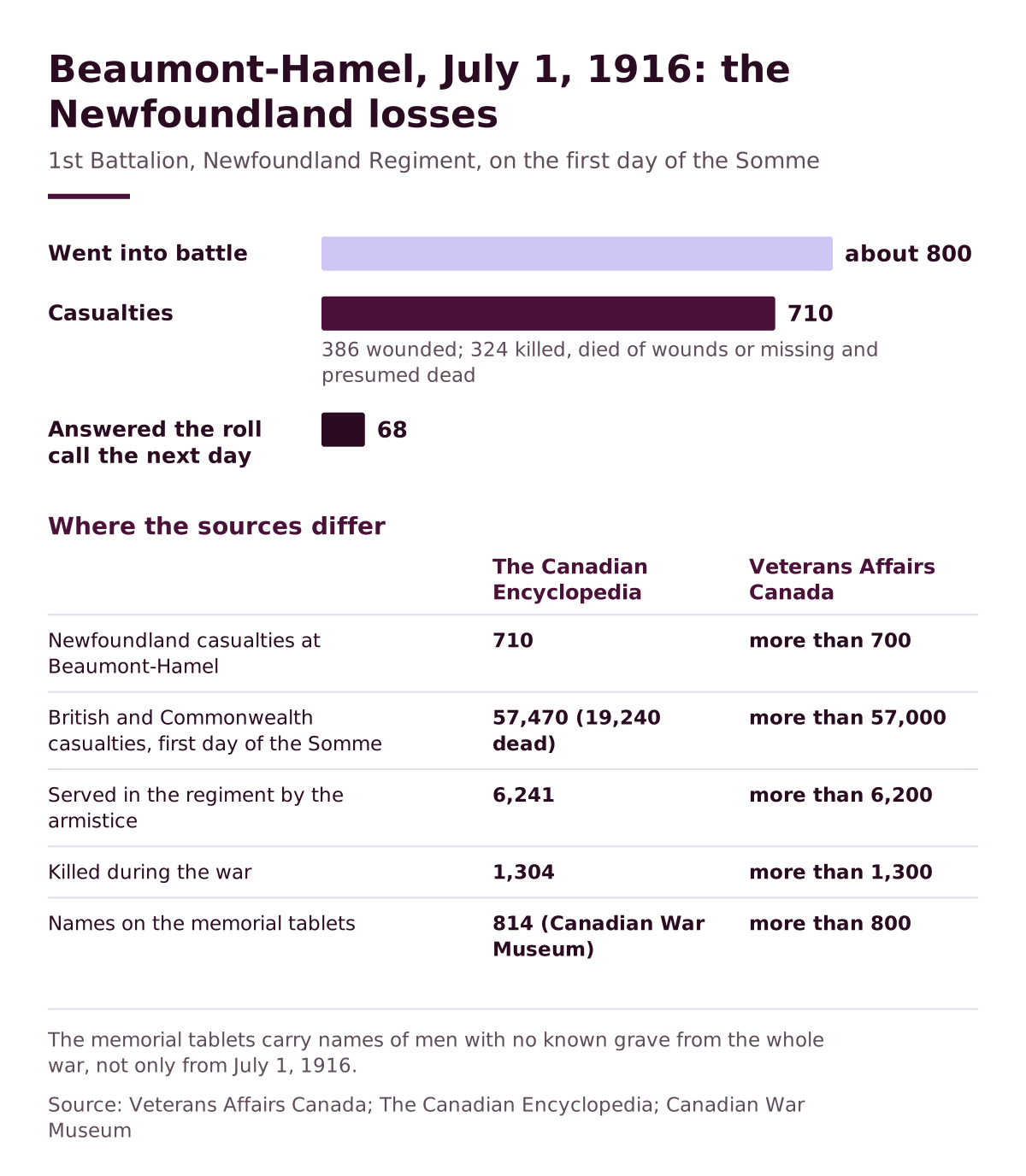
For the whole day, the encyclopedia gives 57,470 British and Commonwealth casualties, 19,240 of them dead, and about 8,000 German casualties. Veterans Affairs Canada uses the round figure of more than 57,000 and calls it the heaviest single-day loss in the British Army's history.
The war-long totals differ a little more, mostly because the sources count different groups. The Canadian Encyclopedia gives 6,241 men who served in the regiment by the armistice and 1,304 killed, more than one in five. Veterans Affairs Canada rounds those to more than 6,200 and more than 1,300, and adds about 2,500 wounded or taken prisoner. The Rooms, the provincial museum and archives in St. John's, lists more than 6,700 names in its Military Service Files, including the Newfoundland Forestry Companies. Its Died in Service database holds some 1,800 biographies of people who died while serving in the regiment, the Canadian Expeditionary Force, the British Army, the Australian Imperial Force or the Royal Naval Reserve (Newfoundland).
If you are tracing a Newfoundland relative from that war, those two databases at The Rooms are the place to start: each record carries a regimental number, and the service files note whether the person was taken prisoner or decorated.
The regiment was rebuilt with fresh drafts and fought on at Gueudecourt, Ypres, Arras, Courtrai and Cambrai. In 1917 it was given the "Royal" designation, which both sources describe as the only such honour granted to a unit during the war.
Memorial Day before Canada Day
News reaching St. John's in the first days spoke of victory. The Canadian Encyclopedia describes how, over the following weeks, families across the colony learned what had actually happened. The first Memorial Day was organized in St. John's on July 1, 1917, and legislation a year later made July 1 Newfoundland's official day of remembrance.
When Newfoundland joined Canada in 1949, its day of mourning became the national holiday as well. The province keeps both. On June 30, 2026, the provincial government announced that ministers would attend the Memorial Day ceremony at the National War Memorial in St. John's in the morning and Canada Day celebrations at Signal Hill afterward, while another minister travelled to France for the Trail of the Caribou commemorations. The release described Memorial Day as "a solemn occasion to remember the Newfoundlanders and Labradorians who served and sacrificed, including those who fought at Beaumont-Hamel on July 1, 1916."
The caribou, the tablets and the Danger Tree
The battlefield itself is now a memorial park, and one of only a few places on the old Western Front where the trench lines survive in recognizable form. The Canadian War Museum says it was opened by Field Marshal Earl Haig on June 7, 1925, and became a Canadian National Historic Site in 1997. A bronze caribou, the regiment's emblem, stands on a rocky outcrop at the highest point, above three bronze tablets near the Newfoundland forward trenches.
The tablets carry the names of men with no known grave, and here the count again varies by source. The war museum gives 814 names, drawn from the regiment, the Newfoundland Royal Naval Reserve and the Mercantile Marine, and covering the whole war rather than one day. It adds that some bodies were recovered and identified after 1925. Veterans Affairs Canada says simply more than 800.
The park also holds three war cemeteries and the Danger Tree, which marks the spot where many Newfoundlanders fell. Veterans Affairs Canada reports that a replica made by Memorial University of Newfoundland was installed there in June 2026.
The Vancouver Island Military Museum on Cameron Road
The Vancouver Island Military Museum, on the second and third floors of the old Centennial Museum building at 100 Cameron Road, is where Nanaimo keeps its own record of those years. According to the Nanaimo News Bulletin, it began with a Remembrance Day display in 1985 at Rutherford Mall, now Nanaimo North Town Centre. The mall asked founder Ted Brothers to set up a table; it grew into a storefront and then two units. The museum was incorporated in 1986 and moved downtown in 2010 to the building that architect Les Barley designed for the Nanaimo Museum in 1967.
The museum's own pages describe it as volunteer-run since 1986, with more than 25 exhibits covering Canadian military history from the War of 1812 to Afghanistan, with sections on the home front and the Merchant Navy. First World War material includes an exhibit on the Chinese Labour Corps, described in 2024 by Brian McFadden, then the museum's vice-president. The Bulletin's account of his work says an estimated 80,000 Chinese labourers crossed Canada by sealed train from Victoria to Halifax in 1917, and more than 2,000 died in Europe while working near the front. The museum also maintains a display at the Nanaimo-Collishaw Air Terminal on Raymond Collishaw, the First World War air ace for whom the airport terminal is named.
On the outside wall, 414 black granite plaques make up the Veterans Wall of Honour, dedicated on June 16, 2016, by Lieutenant Governor Judith Guichon. The museum is careful about what the wall is: "it is not a memorial", it says, but a record of service, showing names, branches and dates without rank or awards.
The museum's governance is changing. In October 2024, city council dropped its rent and started work on a co-management agreement; the Bulletin reported at the time that co-management would begin in January 2025. A city public notice published in March 2026 then set out a ten-year licence effective January 1, 2027, with $269,000 in annual assistance to be budgeted in the 2027 financial plan. Volunteers still run the day-to-day operation. The arrangement follows the model the city already uses for other cultural venues on the mid island, among them the Port Theatre, which its society co-manages with the city, and the museum's own pages place it close to that theatre and the downtown conference centre.
Dallas Square's 1921 cenotaph and Nanaimo's First World War dead
The city's own First World War memorial is the cenotaph in Dallas Square Park, 85 Church Street. The register of Canada's Historic Places describes a granite monument about 14 feet tall, built in 1921 to honour local men killed in the First World War, with bronze plaques that now also carry names from the Second World War and the Korean War. It was designated a heritage site by the city in 2002.
Christine Meutzner, manager of the Nanaimo Community Archives, told the Bulletin in 2023 that records credit the design to C.E.J. Millins, a local monument maker who also made gravestones. The records on how it was paid for are thin, she said, though they suggest a lot of community fundraising. That year, a city idea to move the cenotaph to a corner of the park during a redesign met firm opposition from Legion Branches 10 and 256. "It's been there since 1921 so why would we want to move it?" said Lew Forth, past president of Branch 256 Mount Benson.
The square is getting attention again. On July 20, 2026, council voted unanimously for staff to work with both Legion branches on a crosswalk design honouring veterans, preferably near the cenotaph, though the city's engineering manager warned the location might not meet the city's criteria for painted crossings.
Remembrance Day in Nanaimo, Lantzville and Ladysmith
On November 11, 2025, the city ceremony at Dallas Square Park began at 10:50 a.m. with a parade, gun salutes, a moment of silence, wreath laying and a flyover from CFB Comox. Lantzville held its own at Huddlestone Park from 10:30 a.m. Since 2019, air, sea and army cadets have kept an overnight guard at the Nanaimo cenotaph on the eve of the ceremony, a tradition started by Capt. David Ruel of 205 Collishaw Royal Canadian Air Cadets. The armed forces are still a working presence on this coast, as the Whiskey Golf test range off Nanoose Bay shows.
Ladysmith's war memorial was unveiled on January 29, 1923, in a snowstorm, by Brig.-Gen. R.P. Clark, and has moved three times before reaching Cenotaph Park at Warren Street and the Trans-Canada Highway. It carried 40 names at its dedication. Volunteers at the Ladysmith Archives have since found 17 local people whose names are missing from it. Two of the names that are on it belong to men nobody has been able to identify, even after volunteers John and Esther Sharp searched service records in the United Kingdom and visited burial grounds in Europe.
Questions
Was Newfoundland part of Canada at the Battle of Beaumont-Hamel?
No. In 1916 Newfoundland was a separate dominion of the British Empire, and it went to war automatically when Britain did in August 1914. It became Canada's 10th province on March 31, 1949, after a 1948 referendum.
How many Newfoundlanders died at Beaumont-Hamel?
The Canadian Encyclopedia puts the regiment's losses on July 1, 1916, at 710: 324 killed, died of wounds or missing and presumed dead, and 386 wounded. Veterans Affairs Canada gives rounder figures, more than 700 killed, wounded or missing out of about 800 who went into battle.
Why is July 1 Memorial Day in Newfoundland and Labrador?
It marks the anniversary of the regiment's attack at Beaumont-Hamel. The first Memorial Day was held in St. John's on July 1, 1917, and legislation the following year made it the official day of remembrance. Since 1949 the date has also been Canada Day, and the province observes both.
Who were the Blue Puttees?
They were the first recruits of the Newfoundland Regiment, who went overseas in October 1914. When khaki ran short, navy cloth was used for their puttees, the cloth wrappings worn around the lower leg, and the nickname stuck.
What is the Danger Tree at Beaumont-Hamel?
It is a tree in the battlefield park that marks the spot where many Newfoundlanders fell on July 1, 1916. Veterans Affairs Canada reports that a replica made by Memorial University of Newfoundland was installed there in June 2026.
How many names are on the Beaumont-Hamel caribou memorial?
The Canadian War Museum gives 814 names on the three bronze tablets, covering men of the Newfoundland Regiment, the Newfoundland Royal Naval Reserve and the Mercantile Marine who died in the war and have no known grave. Veterans Affairs Canada says more than 800.
How can you look up a soldier of the Newfoundland Regiment?
The Rooms in St. John's runs two online databases. Military Service Files covers more than 6,700 members of the regiment and the Newfoundland Forestry Companies, and Died in Service holds some 1,800 short biographies of people who died in the war.
Where is the Vancouver Island Military Museum?
It is at 100 Cameron Road in downtown Nanaimo, in the second and third floors of the 1967 Centennial Museum building near the waterfront. Current opening hours are posted on the museum's own website, militarymuseum.ca.
Who runs the Vancouver Island Military Museum?
It is a volunteer-run charity, incorporated in 1986, whose volunteers are mostly military veterans. The City of Nanaimo agreed in 2024 to bring it into a co-management model, and a 2026 public notice set out a ten-year licence starting January 1, 2027.
When was the Nanaimo cenotaph built?
The granite cenotaph in Dallas Square Park, at 85 Church Street, was built in 1921 to honour local men killed in the First World War. Bronze plaques now also carry names from the Second World War and the Korean War.
What time is the Remembrance Day ceremony in Nanaimo?
In 2025 the city ceremony at the Dallas Square Park cenotaph began at 10:50 a.m. on November 11, with gun salutes, a moment of silence and wreath laying. Times can shift from year to year, so check the Legion branches' notices in early November.
Is there a First World War memorial in Ladysmith?
Yes. Ladysmith's war memorial was unveiled on January 29, 1923, in a snowstorm, and now stands in Cenotaph Park at Warren Street and the Trans-Canada Highway. It carried 40 names when it was dedicated.
Sources
- Battle of Beaumont-Hamel, Veterans Affairs Canada, 2026-06-30
- The Newfoundland Regiment and the Battle of Beaumont-Hamel (lesson plan), Veterans Affairs Canada
- The Newfoundland Regiment at Beaumont-Hamel, The Canadian Encyclopedia
- Newfoundland and Labrador and Confederation, The Canadian Encyclopedia
- Beaumont Hamel, Canadian War Museum
- Beaumont-Hamel and the Trail of the Caribou, The Rooms
- Military Service Files, The Rooms
- Died in Service, The Rooms
- Media Advisory: Premier and Ministers to Attend Memorial Day and Canada Day Ceremonies, Government of Newfoundland and Labrador, 2026-06-30
- History of the Vancouver Island Military Museum, Vancouver Island Military Museum
- Museum Exhibits, Vancouver Island Military Museum
- Veterans Wall of Honour, Vancouver Island Military Museum
- Vancouver Island Military Museum marks 40 years honouring military history, Nanaimo News Bulletin (Chris Bush), 2026-01-22
- City of Nanaimo to co-manage Vancouver Island Military Museum, Nanaimo News Bulletin (Chris Bush), 2024-11-08
- Notice of Disposition of Real Property for the Vancouver Island Military Museum, City of Nanaimo public notice, Nanaimo News Bulletin, 2026-03-13
- Vancouver Island Military Museum exhibit will recognize Chinese Labour Corps, Nanaimo News Bulletin (Chris Bush), 2024-04-12
- Dallas Square Cenotaph, Canada's Historic Places
- Nanaimo's downtown cenotaph will stay where it is, Nanaimo News Bulletin (Karl Yu), 2023-11-10
- Cadets start overnight honour guard at Nanaimo cenotaph, Nanaimo News Bulletin (Greg Sakaki), 2023-11-10
- Nanaimo and Lantzville getting ready for Remembrance Day ceremonies, Nanaimo News Bulletin (Karl Yu), 2025-11-09
- Nanaimo gathers for moment of silence on Remembrance Day, Nanaimo News Bulletin (Greg Sakaki), 2025-11-11
- Nanaimo eyes painted crosswalk honouring veterans near Dallas Square Cenotaph, Nanaimo News Bulletin (Robert Barron), 2026-07-29
- Ladysmith pays respects on cenotaph's 100th anniversary, Nanaimo News Bulletin, 2023-01-31


