
In late August 1852, Joseph McKay of the Hudson's Bay Company came ashore beside the main coal seam on Nanaimo harbour and held a conference with the people who were already working it. His journal, transcribed by the Nanaimo Community Archives, notes that they complained about the low price the company vessel Cadboro had paid them for their coal. That complaint is a good place to start the history of Nanaimo coal, because it shows the seam was known, dug and traded by Snuneymuxw people before the company's miners set foot on the beach.
The century that followed turned a harbour village into a company town and then a city. It also produced British Columbia's worst mining disaster, a two-year strike broken by soldiers, and a concrete headframe south of town that volunteers spent sixteen years trying to save. Below, the history of Nanaimo coal runs in order, and where sources disagree on a date, a price or a death toll, both figures are given. Most of the other early Nanaimo history stories lead back to it sooner or later.
Snuneymuxw coal and the Hudson's Bay Company, 1849 to 1854
The Snuneymuxw, a Coast Salish people, lived around what are now Departure Bay and Nanaimo, according to the City of Nanaimo's own history of the town, in cedar-plank longhouses about 100 feet long. In 1849 the Hudson's Bay Company opened a mine at Fort Rupert on the northern tip of the island, and the Dictionary of Canadian Biography describes that venture as failing: the coal was limited, management was poor and the miners were restless. Between 1851 and 1853 the company moved its mining equipment south to the newly found Nanaimo field.
McKay formally took possession of the Nanaimo coalfields for the company in August 1852. His orders, given verbally, were to sell coal to any ship that called at $10 a ton. What the journal records next is less often told. Snuneymuxw workers dug the coal and carried it to the Cadboro, and the company paid them in goods, at twenty barrels of coal per blanket. A leader McKay names as WunWunShun, "the principal Nanaimo chief", told him the coal was worth one blanket for every five barrels and refused to hear any proposal to let the newcomers work it themselves. The gap between those two prices is a factor of four. Blankets carried far more than trade value on this coast: Coast Salish nobility blankets, woven from mountain-goat wool and woolly-dog hair, were prestige belongings that moved through the potlatch.
The Cadboro left with about 45 tons, and the company's miners began boring into the seam beyond its first outcrop. Later entries note that the Snuneymuxw returns were falling, because the five-foot seam had been worked out well below the high-water mark.
The settlement was first called Colvile Town after Andrew Colvile, the company's governor. A year after McKay arrived, Governor James Douglas visited and wrote, in a line the Dictionary of Canadian Biography quotes, "The place has quite the appearance of a little village."
In the fall of 1854 came treaty meetings. Snuneymuxw First Nation describes the result, the Sarlequun Snuneymuxw Treaty of December 23, 1854, as an agreement to preserve and protect Snuneymuxw villages, enclosed fields, waterways, harvesting and gathering, and the rights to hunt and fish "as formerly". In the Nation's account of those meetings, "the coal could be shared, but the land and water would be preserved and protected." In 2021 the Nation signed a memorandum of understanding with Canada and B.C. on recognizing and implementing the treaty. The City's history records the other side of the ledger: many Snuneymuxw worked for the company, yet in 1862 they were removed from their village near Cameron Island to their southern village site, now Reserve No. 1.
The 1854 families and the Vancouver Coal Company
The town grew in 1854 when 24 mining families arrived from England, a figure the City of Nanaimo and The Canadian Encyclopedia agree on. The company put them in a row of timber cottages on Front Street, each about 600 square feet, built as duplexes around a shared central chimney.
Among the miners who had come down from Fort Rupert was Robert Dunsmuir, a Scot from near Kilmarnock who had reached the island in September 1851 with his wife and three children. In 1855 he refused to join a strike by other miners, and the company rewarded him with a free miner's licence to work an abandoned shaft.
In 1860 Colvile Town became Nanaimo, a name derived from the Snuneymuxw name for the area; The Canadian Encyclopedia glosses it as "gathering place". Two years later the Hudson's Bay Company sold its mines, buildings and 6,193 acres of land to the British-owned Vancouver Coal Mining and Land Company. Under its manager, Charles Nicol, the new owner commissioned a town plan in 1864 that gave Nanaimo its fan of downtown streets running down the slope to the harbour, then auctioned the lots. Nanaimo was incorporated in 1874.
Robert Dunsmuir and the Wellington mines
Dunsmuir spent the 1860s supervising mines for others and quietly prospecting on the side. In 1869 he found the Wellington seam, about five miles northwest of the harbour and, according to his biographer in the Dictionary of Canadian Biography, the thickest and most extensive seam yet found in the Nanaimo basin. Naval officers at Esquimalt, among them Lieutenant Wadham Neston Diggle, put up £32,000. The firm became Dunsmuir, Diggle Limited in 1873, and a railway carried the coal three miles to wharves on Departure Bay.
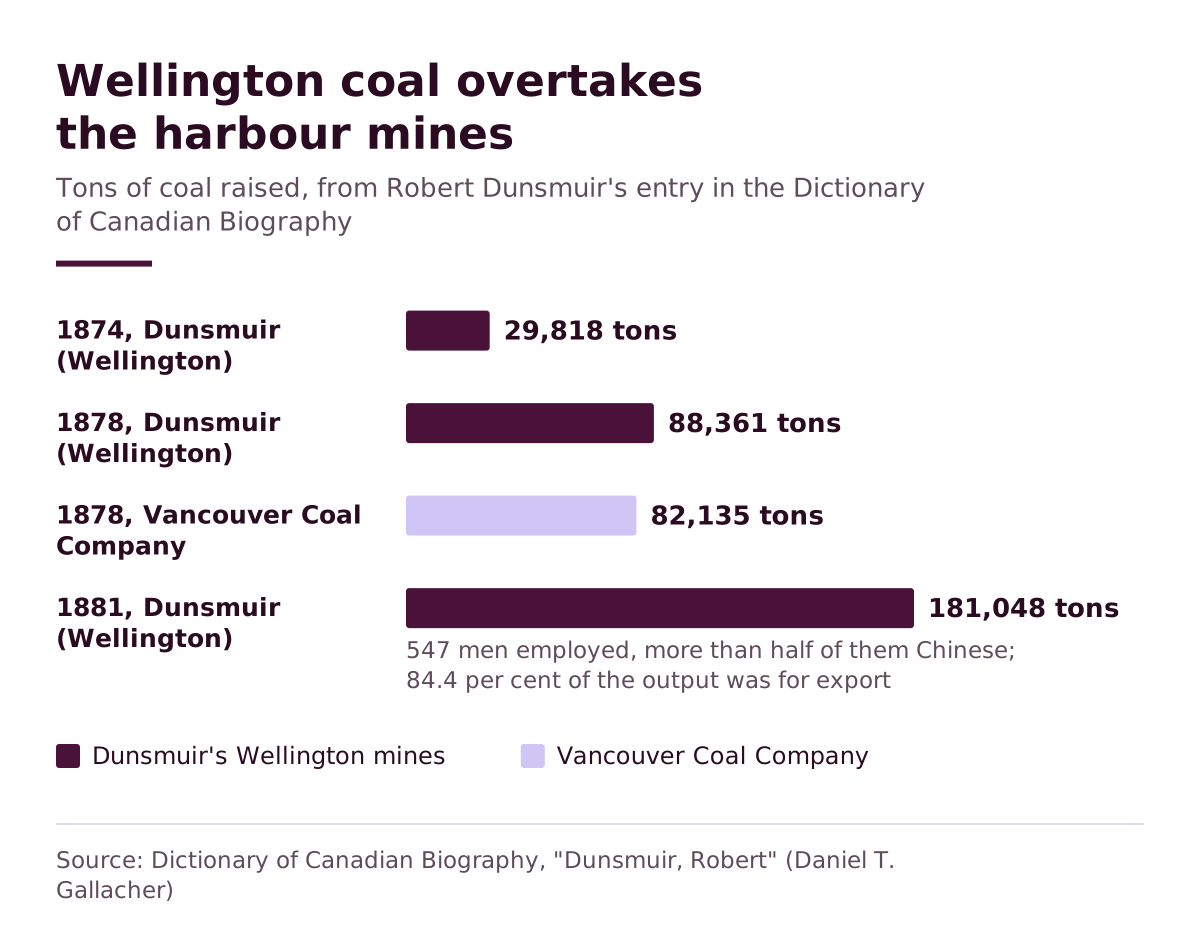
The figures show how quickly the Wellington pits overtook the older Nanaimo coal mines at the harbour. In 1874 Dunsmuir raised 29,818 tons. By 1878 he had overtaken the Vancouver Coal Company, 88,361 tons to its 82,135. By 1881 he employed 547 men, more than half of them Chinese, and produced 181,048 tons, 84.4 per cent of it for export.
The biography is blunt about how this was done. Dunsmuir paid lower wages than his competitors and preferred Chinese workers, who were paid half what other miners accepted. In 1877, when miners threatened to strike over pay, he locked them out for four months, had police and militia sent north from Victoria, and took the men back at a maximum of $2.50 a day, a third below what his best-paid workers had earned. Chinese workers had come to Nanaimo as early as the 1860s, the City notes, to work in the mines or open businesses, and they built their own community in Nanaimo's Chinatown.
Dunsmuir then built the Esquimalt and Nanaimo Railway, whose last spike Sir John A. Macdonald drove at Shawnigan Lake on August 13, 1886. The payment was $750,000 and a vast land grant with its coal rights. The two reference works describe that grant differently: the Dictionary of Canadian Biography says some two million acres, "fully one-fifth of Vancouver Island", while The Canadian Encyclopedia says about one-quarter of the island. His biographer called him "the most controversial person in the province's history".
The 1887 explosion in the No. 1 Esplanade Mine
At 5:55 p.m. on May 3, 1887, explosions tore through the No. 1 Esplanade Mine, the largest in the city, about 260 metres below sea level. The City of Nanaimo counts 150 dead in a community of about 2,000 people. Forty-six women lost their husbands, 126 children lost their fathers, and the mine lost a quarter of its workforce. An inquest jury blamed the firing of an unprepared and badly planted charge, which ignited accumulated gas, with coal dust feeding the blast.
The City calls it the worst mining disaster in British Columbia's history and the second-worst industrial accident in Canada, after the 1914 Hillcrest mine disaster in Alberta, which killed 189. The Canadian Encyclopedia gives the same 150 for Nanaimo. It was not the first disaster on the field: the Dictionary of Canadian Biography mentions a disaster at Wellington in 1876, and notes that colliery owners, the Dunsmuirs included, resisted many of the safety demands of provincial mine inspectors.
Since 2015, by council resolution, flags at City facilities fly at half-mast every May 3. If you go looking for the memorial plaque, note that the City's 2023 release gives its address as 1151 Milton Street in the text and 1551 Milton Street in the photo caption; look for it at the old mine site on Milton Street rather than by house number.
Sold, merged and struck: Nanaimo coal mines from 1910 to 1914
James Dunsmuir, Robert's son, ran the family collieries until 1910 and fought two long strikes, in 1890 to 1891 and in 1903. In 1910 he sold the coal business to William Mackenzie and Donald Mann of the Canadian Northern Railway. The price differs by source: $11,000,000 in the Dictionary of Canadian Biography, $10 million in The Canadian Encyclopedia. The new owners named their subsidiary Canadian Collieries (Dunsmuir) Limited. On the Nanaimo side of the field the Western Fuel Company was at work by then, and the City of Nanaimo credits it with building the Chase River dams in 1910 and 1911 for coal washing and firefighting; two of those dams stand in Colliery Dam Park.
An explosion at Extension in 1909 killed 32 men, according to On the Line, a labour history published by Harbour Publishing. In June 1912 Oscar Mottishaw, a member of the miners' safety committee, reported gas at Extension; a mines inspector confirmed it, and Mottishaw soon lost his job. When he was dismissed again at Cumberland, miners there, and by On the Line's account at Extension too, declared a "holiday" on September 16, 1912. Canadian Collieries locked them out and brought in strikebreakers. The Canadian Encyclopedia names the issues as safety and recognition of the United Mine Workers of America.
By spring 1913 the strike covered Nanaimo, Extension, South Wellington and Ladysmith. The Canadian Encyclopedia puts the number off work at 3,500; On the Line says 3,700 after the May Day rally of 1913. In August, rioting broke out across the coal towns. Strikers drove strikebreakers out of South Wellington, attacked bunkhouses of Chinese workers and ransacked Ladysmith's Chinatown. The province sent in the militia, about 1,000 men in The Canadian Encyclopedia's count, and troops cleared a meeting of more than a thousand miners at Nanaimo's Athletic Hall. In all, 213 strikers were arrested. One of the jailed, Joseph Mairs, died in Oakalla prison two weeks before his 22nd birthday.
Strike pay was cut off in July 1914. A month later, two weeks after the First World War began, the miners voted to go back after 23 months. By then, The Canadian Encyclopedia notes, the mines were running at almost their pre-strike capacity with newly hired labour.
Peak and decline in the last decades of Nanaimo coal history
The City's history calls 1881 to 1925 Nanaimo's most productive and prosperous years, when coal was the main fuel of the western world and brick blocks replaced wooden storefronts on Commercial Street. Production from the area's three main seams peaked in 1923 at more than a million tonnes, according to The Canadian Encyclopedia. After that the easy coal was gone, and what remained was more dangerous and more expensive to reach.
The Canadian Encyclopedia records that union recognition finally came to Vancouver Island coal in 1938, six weeks after the Island's largest mine had shut down for good. The City's history describes what followed in a single line: one by one, the Nanaimo coal mines closed as oil replaced coal. By the early 1950s the city had turned to forest products, and the Harmac pulp mill opened in 1950, outside the city limits. Pulp and paper created a blue-collar middle class, the households that served dainties such as the Nanaimo bar, first printed in a 1952 Nanaimo hospital auxiliary cookbook.
The cost of those decades can be traced name by name. The Nanaimo Community Archives keeps a searchable database of nearly 2,000 mining accident records from the Nanaimo area between 1877 and 1952, taken from the Minister of Mines annual reports.
Morden Mine and the Friends of Morden Mine Society
About 7 km south of Nanaimo, off Highway 1 on Morden Road, a reinforced concrete headframe and coal tipple stand on a wooded four-hectare site. They belonged to the Morden Colliery of the Pacific Coast Coal Mines Company, whose initials, PCCM, are cast into a concrete arch near the tipple. BC Parks says the first sod was turned in 1912 and that the mine produced 76,000 tonnes in its first year. The Canadian Register of Historic Places dates construction to about 1913 and the main working life to 1914 to 1921, while the BC Parks Blog says the mine operated from 1913 to 1921. BC Parks calls the operator the Pacific Coal Company.
What makes the site unusual is the material. Wooden headframes and tipples at most other local mines were lost to decay; this one, about 23 metres tall, survived because it was concrete. The register calls it the last remaining headframe and tipple on Vancouver Island and one of only two reinforced concrete structures of its kind in North America, the older of the two. The province made the site a historic park in 1972.
Heritage BC put the structure on its 2018 watchlist as a significant site at risk of destruction. The BC Parks Blog credits a volunteer society, the Friends of Morden Mine, with 16 years of work to save it. Borrowing a method used after the magnitude 6.2 earthquake in Christchurch, New Zealand, in February 2011, the society and Heritageworks Ltd. of Victoria designed an emergency stabilization based on a laser scan. In May and June 2019, contractors and volunteers set 16 shipping containers around the headframe and tipple, some lifts weighing almost 8,000 kilos and threaded through with less than two centimetres to spare on each side. The B.C. government contributed $1.4 million.
The area around the tipple is fenced, and BC Parks prohibits entry inside the fence. The Regional District of Nanaimo's Morden Colliery Regional Trail follows the old rail grade that carried the coal, from the parking lot to the Nanaimo River.
What remains in town: the Bastion, a cottage and the shoreline
The Bastion on Front Street is the oldest survivor of the company years. The sources do not agree on its date: the City's history says it was built in 1852 by two French-Canadian axemen, while the Nanaimo Museum says construction began in 1853, and the Dictionary of Canadian Biography places it in 1853 under Douglas. The museum notes that it has been moved twice, in 1891 after the land was sold, with $175 from the city, and in 1974 when Front Street was widened.
At Piper Park, the museum keeps a miner's cottage built by Frederick Rowbottom in the 1890s on Farquhar Street, two rooms at first and now 360 square feet, where up to eight people may have lived. The ground itself keeps a quieter record. Mine tailings filled the tidal ravine that once divided downtown along Terminal Avenue and pushed the waterfront outward, according to the City.
Where the figures disagree
| Detail | One source | Another source |
|---|---|---|
| Bastion built | 1852 (City of Nanaimo history) | 1853 (Nanaimo Museum; Dictionary of Canadian Biography) |
| Coal at Nanaimo | "discovery of coal in 1852" (The Canadian Encyclopedia) | Snuneymuxw already selling coal to the Cadboro on McKay's arrival, August 1852 (McKay journal) |
| E&N land grant | about 2 million acres, one-fifth of the island (Dictionary of Canadian Biography) | about one-quarter of the island (The Canadian Encyclopedia) |
| 1910 sale of Dunsmuir collieries | $11,000,000 (Dictionary of Canadian Biography) | $10 million (The Canadian Encyclopedia) |
| Strikers off work, 1913 | 3,500 (The Canadian Encyclopedia) | 3,700 (On the Line) |
| Morden mine working years | 1914 to 1921 (Historic Places register) | 1913 to 1921 (BC Parks Blog); first sod 1912 (BC Parks) |
| Raven mine life | 17 years (B.C. EAO record) | 16 years (federal registry; 2011 project description) |
| Raven termination | April 4, 2016 (EAO letter) | April 6, 2016 (EAO project summary) |
The Raven Coal Mine proposal in the Comox Valley
The most recent attempt to open a coal mine on the island never got past the paperwork. In 2010 Compliance Coal Corporation, doing business as the Comox Joint Venture, entered a joint provincial and federal environmental assessment for the Raven Underground Coal project near Buckley Bay, about 20 km south of Courtenay according to the federal registry. The plan called for an underground mine and processing plant on a footprint of about 200 hectares, with trucks carrying coal to an upgraded terminal at Port Alberni.
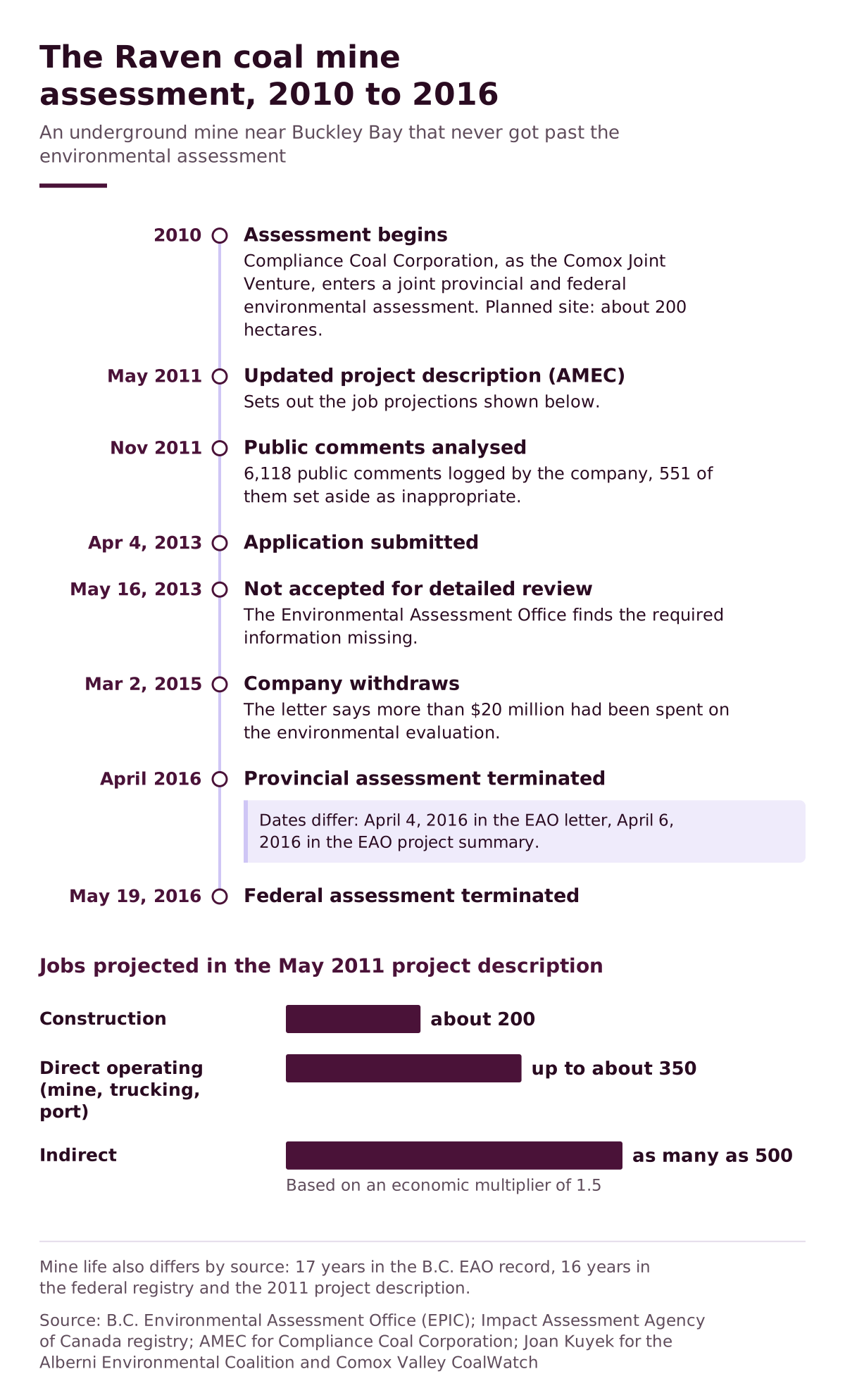
The company's updated project description of May 2011, prepared by AMEC, set out the job projections that dominated local debate: about 200 workers during construction, a direct operating workforce of up to about 350 across the mine, trucking and port, and as many as 500 indirect jobs, based on an economic multiplier of 1.5. A November 2011 analysis written for the Alberni Environmental Coalition and Comox Valley CoalWatch reported that Compliance had logged 6,118 public comments and set aside 551 of them as inappropriate, and that nearly 200 pages were classed as statements of opposition.
The application arrived on April 4, 2013. On May 16 the Environmental Assessment Office told the company that it did not contain the required information and would not be accepted for detailed review. On March 2, 2015, Compliance president Stephen Ellis withdrew the revised submission, writing: "We received some misinformation that is circulating in some communities regarding the Raven Project and believe it is appropriate that we withdraw the project from the screening process at this time." The same letter said more than $20 million had been spent on the environmental evaluation.
On April 4, 2016, Kevin Jardine of the Environmental Assessment Office terminated the provincial assessment, noting that nothing had been heard from the company since March 2015 and that the decision was "not a reflection of the Raven project or potential effects related to the project." The federal registry records its own assessment as terminated on May 19, 2016. Any revival, the termination letter says, would need a new project description, a new Section 11 order and new fees.
Questions
When did coal mining start in Nanaimo?
The Hudson's Bay Company took formal possession of the Nanaimo coalfields in August 1852, according to the Dictionary of Canadian Biography. Joseph McKay's journal from that summer shows Snuneymuxw people were already digging coal and selling it to the company's ships when he arrived.
Who first mined coal at Nanaimo?
The earliest workers recorded at the harbour seam were Snuneymuxw people, who dug the coal and loaded it into the Cadboro in 1852, paid in blankets and other goods. Company miners, among them the Muir family, landed shortly afterwards and began boring into the same five-foot seam.
What did the 1854 treaty say about coal?
Snuneymuxw First Nation describes the Sarlequun Snuneymuxw Treaty of 1854 as protecting villages, fields, waterways and the rights to hunt and fish as formerly. In the Nation's account of the treaty meetings, the coal could be shared while the land and water were to be preserved and protected.
Who owned the Nanaimo coal mines?
The Hudson's Bay Company ran them until 1862, when it sold to the British-owned Vancouver Coal Mining and Land Company. Robert Dunsmuir's family firm worked the Wellington field from 1869, its collieries passed to Mackenzie and Mann's Canadian Collieries in 1910, and the Western Fuel Company was operating in Nanaimo by 1910.
How many miners died in the 1887 Nanaimo mine explosion?
The City of Nanaimo and The Canadian Encyclopedia both give 150 deaths in the No. 1 Esplanade Mine on May 3, 1887. The City counts 46 widows and 126 children who lost their fathers.
What caused the 1887 explosion?
An inquest jury blamed an unprepared and badly planted charge that ignited gas, with coal dust feeding the blast, according to the City of Nanaimo. The explosions began at 5:55 p.m., about 260 metres below sea level.
Where is the memorial to the 1887 mine disaster?
A memorial plaque stands at the site of the No. 1 Esplanade Mine on Milton Street. City flags have been lowered to half-mast every May 3 since council passed a resolution in 2015.
Can I look up a miner who died in a Nanaimo mine?
The Nanaimo Community Archives runs a searchable database of nearly 2,000 mining accident records from the Nanaimo area between 1877 and 1952. It is drawn from the Minister of Mines annual reports, and the archives note that 1878 and 1880 are missing.
What was the Great Strike of 1912 to 1914?
It was a stoppage that started at Cumberland on September 16, 1912, after the firing of safety committee member Oscar Mottishaw, and spread to Nanaimo, Extension, South Wellington and Ladysmith in 1913. The issues were mine safety and recognition of the United Mine Workers of America.
Why were soldiers sent to Nanaimo in 1913?
After rioting in the coal towns in August 1913, the provincial government sent in militia, about 1,000 men according to The Canadian Encyclopedia. Troops cleared a miners' meeting at Nanaimo's Athletic Hall, and 213 strikers were arrested across the district.
When did the last Nanaimo coal mines close?
There was no single closing date. The Canadian Encyclopedia records that the largest mine on the Island shut down for good in 1938, and that by the early 1950s Nanaimo had turned to forest products, with the Harmac pulp mill opening in 1950.
Is Morden Mine open to visitors?
Morden Colliery Historic Park is a small day-use park about 7 km south of Nanaimo, reached from Highway 1 by Morden Road. The headframe and tipple are fenced and entry inside the fence is prohibited, but they can be seen from the parking area and trail.
Who looks after the Morden headframe?
The park belongs to BC Parks and is run by a contracted park operator. The Friends of Morden Mine, a volunteer society, led the campaign that brought in $1.4 million in provincial money for stabilization work in 2019.
What was the Raven Coal Mine?
It was a proposed underground coal mine near Buckley Bay in the Comox Valley Regional District, put forward by Compliance Coal Corporation. Coal was to be trucked to Port Alberni for export, and the project never received an environmental assessment certificate.
How many jobs did the Raven Coal Mine promise?
The company's 2011 project description projected about 200 construction jobs, up to about 350 direct jobs in operations, and as many as 500 indirect jobs in the local economy. These were the company's own estimates and were never tested in a completed assessment.
What happened to the Raven Coal Mine proposal?
Compliance withdrew its revised application in March 2015, and the province terminated the environmental assessment in April 2016. The federal assessment was terminated in May 2016.
Sources
- Nanaimo's Historical Development (Marie Leduc), City of Nanaimo
- Remembering lives lost in BC's worst mining disaster, City of Nanaimo, 2023-05-02
- Chase Dams, City of Nanaimo
- HBC Fonds: Transcription of Joseph McKay's Journal, August 24th 1852 to September 27th 1854, Nanaimo Community Archives
- Mine Deaths and Accidents database, Nanaimo Community Archives
- Snuneymuxw First Nation (home page, Sarlequun Snuneymuxw Treaty of 1854), Snuneymuxw First Nation
- McKay, Joseph William, Dictionary of Canadian Biography
- Douglas, Sir James, Dictionary of Canadian Biography
- Dunsmuir, Robert (Daniel T. Gallacher), Dictionary of Canadian Biography, 1982
- Dunsmuir, James, Dictionary of Canadian Biography
- Nanaimo, The Canadian Encyclopedia
- Vancouver Island Coal Strike (Lynne Bowen), The Canadian Encyclopedia
- James Dunsmuir, The Canadian Encyclopedia
- Robert Dunsmuir, The Canadian Encyclopedia
- Coal in Canada, The Canadian Encyclopedia
- On the Line, chapter 4: The Great Vancouver Island Coal Strike, Harbour Publishing (KnowBC)
- The Bastion, Nanaimo Museum
- Miners' Cottage, Nanaimo Museum
- Morden Colliery Historic Park, BC Parks
- "Giant Lego Blocks" used to Stabilize the Morden Colliery, BC Parks Blog, Government of British Columbia, 2019-10-09
- Morden Colliery (Canadian Register of Historic Places), HistoricPlaces.ca, BC Heritage Branch and BC Parks
- Morden Colliery Regional Trail, Regional District of Nanaimo
- Raven Underground Coal (project record), B.C. Environmental Assessment Office, EPIC
- Raven Underground Coal Mine Project, reference 55529, Impact Assessment Agency of Canada, Canadian Impact Assessment Registry
- Raven Underground Coal Project: Updated Project Description (AMEC for Compliance Coal Corporation), B.C. Environmental Assessment Office, EPIC, 2011-05
- Socio-Economic Impact Analysis: Analysis of Compliance Coal's response to public comments (Joan Kuyek, for the Alberni Environmental Coalition and Comox Valley CoalWatch), B.C. Environmental Assessment Office, EPIC, 2011-11-25
- Letter from Tracy James (EAO) to John Tapics regarding the evaluation of the Application, B.C. Environmental Assessment Office, EPIC, 2013-05-16
- Letter from Stephen Ellis (Compliance Coal Corporation) to Doug Caul regarding withdrawal of the Application, B.C. Environmental Assessment Office, EPIC, 2015-03-02
- Letter from Kevin Jardine (EAO) to James O'Rourke regarding termination of the EA, B.C. Environmental Assessment Office, EPIC, 2016-04-04


