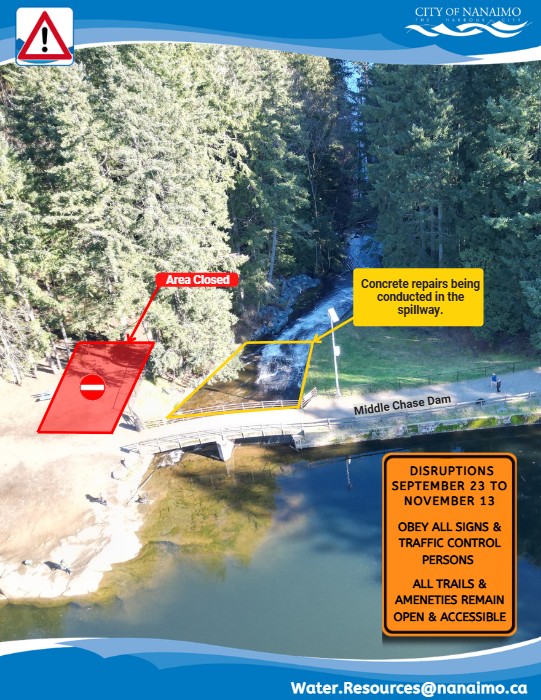
Between September 23 and November 13, 2026, a small patch of shore beside the Middle Chase Dam is off limits while crews patch concrete in its spillway. A City of Nanaimo advisory dated October 16 shows the spot from the air: a red box for the closed area, a yellow outline around the spillway, and a line of text promising that every trail and amenity in Colliery Dam Park stays open. It is a modest notice for a structure the city once voted to tear down.
Colliery Dam Park in Nanaimo is a 27.2-hectare nature park wrapped around two reservoirs on the Chase River, in the Harewood area in the south of the city. People swim off the rocks, fish the stocked lakes and walk dogs on the loop trails. The 2025 inspection report on the city's recreational dams estimates that the park sees hundreds of users a day.
Coal-era dams on the Chase River
The City of Nanaimo says the Western Fuel Company built the Chase River dams in 1910 and 1911 to create reservoirs for coal washing and firefighting. Other sources compress the dates: a 2013 Times Colonist report gives 1910 for both dams in the park, and the engineering firm Hatch, in its 2025 inspection report, dates the Lower Dam to 1910 and the Middle Dam to "around 1910". Hatch adds that the Lower Dam supplied the nearby Harewood Colliery, whose production ended around 1945. The mines that needed all this water were part of the long history of Nanaimo coal mining, which began at the harbour in 1852.
Hatch describes the Lower Dam as an earth and rock fill embankment about 77 metres long and 23.3 metres high, with a thin concrete cut-off wall on its upstream face. At more than 15 metres it counts as a large dam. The Middle Dam is smaller, about 50 metres long, and Hatch gives its height as 12.5 metres in its description and 13.0 metres in its data table. Both were reworked in 1980, when filter drains went in to intercept seepage, and the Middle Dam's crest was raised by 0.3 metres.
Above them sits the Upper Chase Dam, the highest on the river, which the city lists as part of the undeveloped Nanaimo Lakes Road Nature Park. Hatch's 2025 report recommends checking whether a failure there could cascade through the two dams below it.
The 2012 removal vote and the 2013 standoff
The trouble started on paper. Seismic and inundation studies delivered to the province led the Dam Safety Section, then part of the Ministry of Forests, Lands and Natural Resource Operations, to give both dams an "extreme" consequence rating, the highest category in British Columbia. A consequence rating describes what a failure would do downstream, not how likely it is.
Homes in Harewood sit downstream, and the section told the city the risk to them was unacceptable and that leaving the dams without any mitigation for another year was not an option.
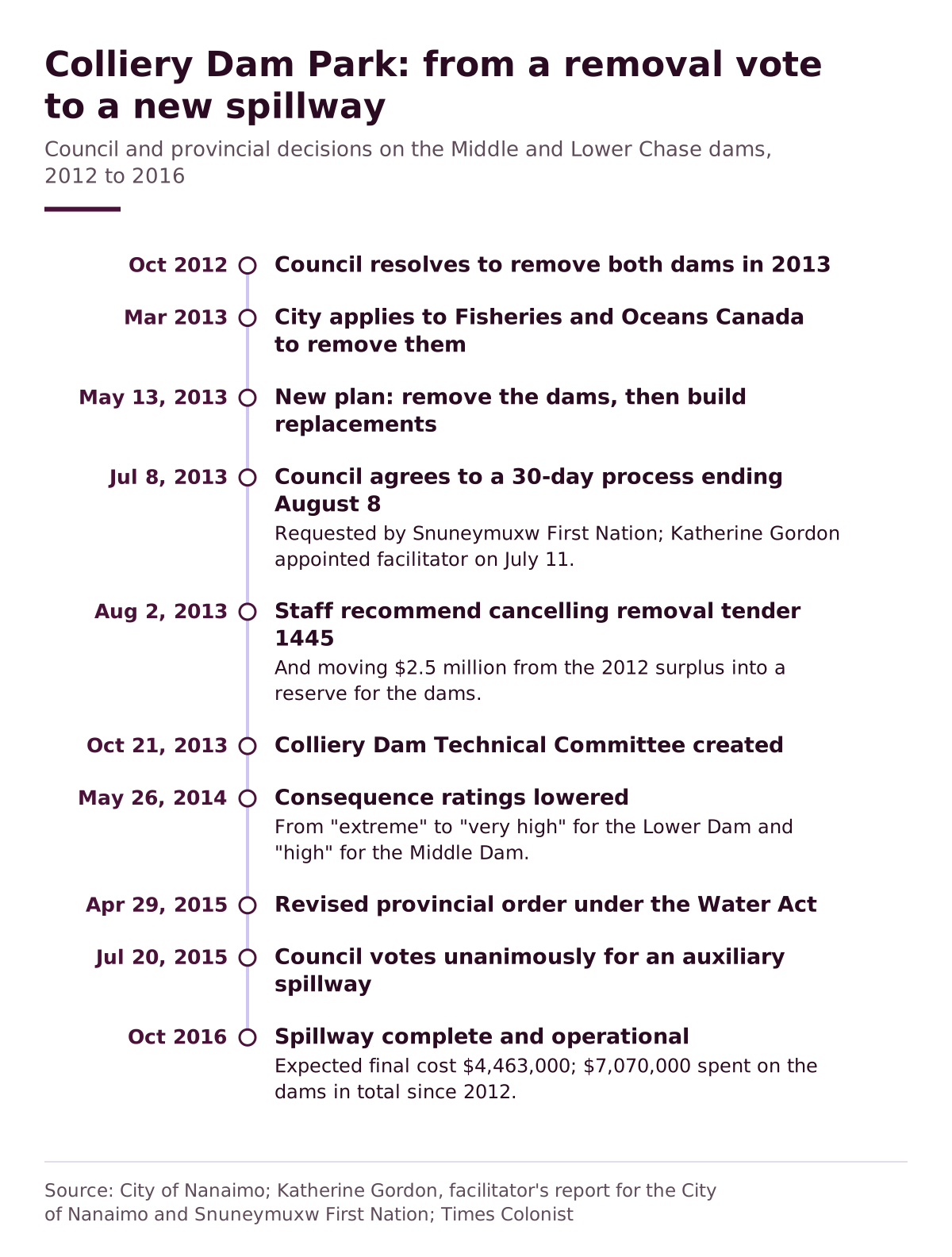
In October 2012, council resolved to remove both the Middle and Lower dams in 2013 and to re-naturalize the river. Residents organized to save the dams, and city records list a December 6, 2012 meeting with leaders of the Save the Dams initiative. In March 2013 the city applied to Fisheries and Oceans Canada for permission to take both dams out.
On May 13, 2013, council changed course and resolved to remove the dams and then build replacements, with the lower one fitted for hydroelectric generation. Critics feared the second half of that plan would never happen. The Snuneymuxw First Nation, whose concern was the Chase River fishery, issued a statement through Chief Douglas White III Kwulasultun asking for a feasibility study of a middle path: lowering both reservoirs to reduce risk over the winter instead of demolishing anything. "Due diligence, responsible decision-making and avoiding deepening the public divisions about the issue all weigh in favour of taking some time to look at all the options," White said, as reported by the Times Colonist on July 8, 2013. The statement also argued that the province had never ordered removal, only a reduction in risk.
The same Times Colonist report noted that a B.C. Supreme Court judge had just rejected the city's application for an injunction against protesters at the dam site, while leaving the door open for a fresh application if demolition work was obstructed.
Thirty days, a facilitator and a change of plan
At its July 8, 2013 meeting, council agreed to Snuneymuxw's request and resolved to hold further discussions over a 30-day period ending August 8, "exhausting all possible options and considerations" before awarding a removal contract. The two governments jointly appointed Katherine Gordon as facilitator on July 11. Her report, dated August 3, is the most detailed public account of that month.
It was not a smooth month. Snuneymuxw withdrew from the process between July 17 and July 22, then rejoined. The nation hired SNC-Lavalin for independent technical advice. Gordon received dozens of emails, some urging that the dams be saved and others wanting them gone because of the risk to homes below. City staff found that the hydroelectric idea would cost far more to build than the power was worth. Most significantly, the engineers working with both parties concluded that repairing the existing dams, rather than replacing them, might be feasible after all.
Gordon also recorded a softening at the province. Dam Safety Section officials told the parties they were extremely unlikely to issue a compliance order forcing removal that year, provided the city put temporary risk measures in place and moved toward a permanent fix.
By August 2, city staff were recommending that council cancel tender 1445, the contract to remove the Middle and Lower Chase dams, and move $2.5 million from the 2012 surplus into a reserve for future work on the dams.
No demolition followed.
Engineers, a technical committee and a lower rating
Council created the Colliery Dam Technical Committee on October 21, 2013, with members from the Colliery Dam Park Preservation Society, Snuneymuxw First Nation and the city, Golder Associates as lead engineer and Gordon again as facilitator. Its mandate was narrow by design: only options that kept and repaired the existing dams. The committee met twice in 2013 and twelve times in 2014.
Its first findings, released on May 26, 2014, changed the terms of the debate. Golder's testing found the concrete walls in good condition with very limited deterioration, essentially unchanged since the 1980 repairs, and judged the chance of a sudden earthquake rupture extremely low. If an earthquake damaged the dams, Golder expected slow leaking through cracks, not a collapse. On that basis the Dam Safety Section agreed to lower the ratings from "extreme" to "very high" for the Lower Dam and "high" for the Middle Dam. The real weakness was flood capacity: in a long, heavy rain the spillways could not pass enough water.
Golder's final report in September 2014 offered two fixes for the Lower Dam: deepen the existing spillway from an average of 1.5 metres to 5 metres, or armour the embankment so it could survive being overtopped. A third idea, a channel from the reservoir into Harewood Creek, had been rejected in March 2014 because it would clear about two acres of park; council asked for a narrower version to be studied that November. In February 2015, after hearing from residents opposed to the drainage course, council set it aside and asked for more time and more consultation.
The 2015 provincial order and the auxiliary spillway
Patience in Victoria ran out that spring. A Dam Safety Section letter of February 25 demanded a plan and timeline by March 27, a first order followed on April 9, and on April 29, 2015, the Comptroller of Water Rights issued a revised order under the Water Act requiring the city to pick one of three Lower Dam options (a labyrinth spillway, an auxiliary spillway or an overtopping design), notify the province by June 1, and have the work substantially complete by November 15, 2015. The same order told the city to evaluate options for the Middle Dam by the end of 2015 and carry out a revised plan no later than 2017.
Council first appealed to the Environmental Appeal Board and won a short temporary stay, but on June 30 the board refused to grant a full one. On July 20, 2015, council voted unanimously to build an auxiliary spillway beside the Lower Dam and to drop its legal proceedings before the board.
Copcan was chosen as contractor on September 2, and site work started that month; a city release scheduled it for the week of September 14, while a later one says work began at the end of September. Initial estimates ranged from $2.8 million to $4.6 million. In October 2016 the city reported the spillway complete and operational, with expected final design and construction costs of $4,463,000, and a total of $7,070,000 spent on the dams since 2012 once engineering, evacuation planning, the select committee and legal fees were counted.
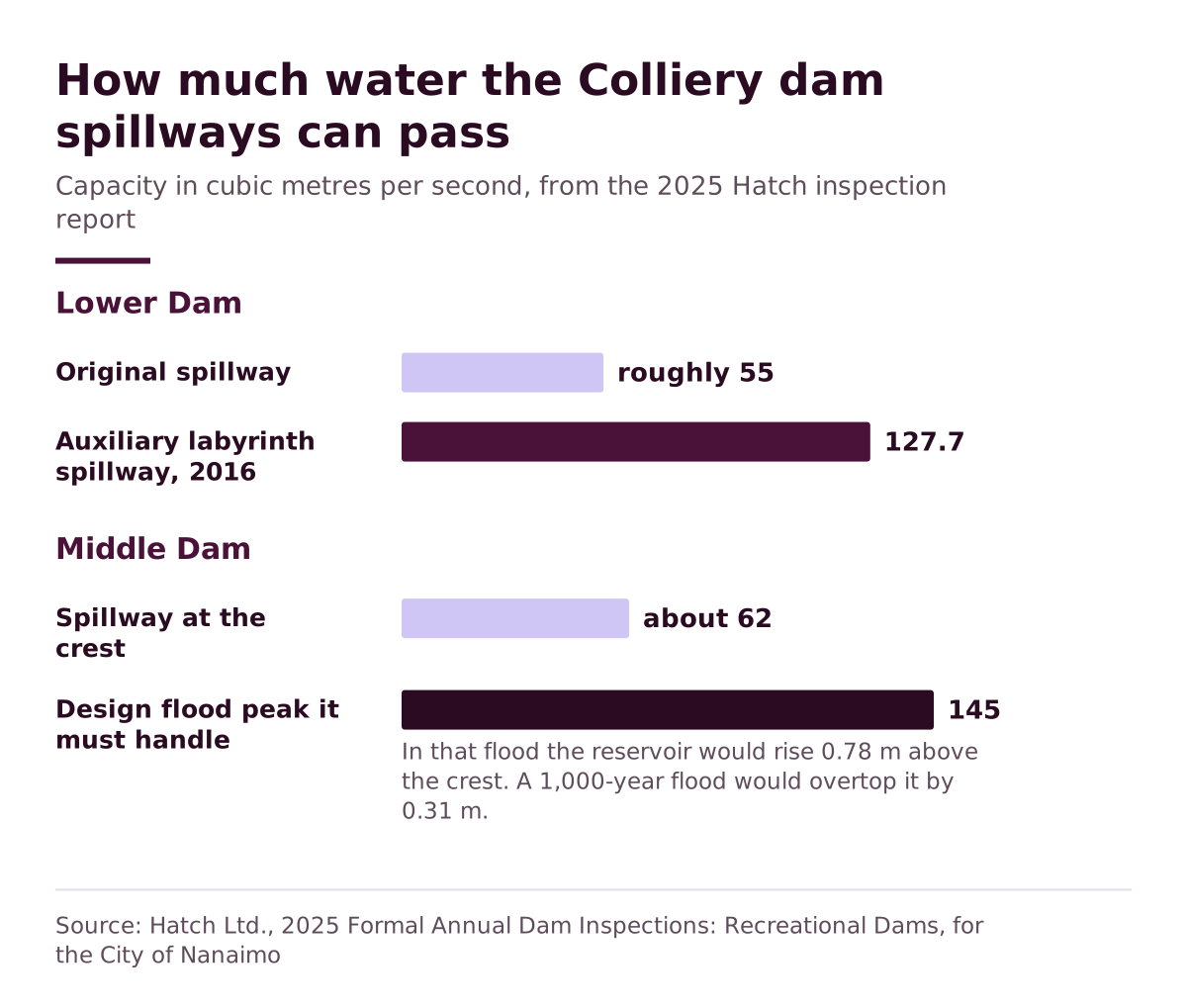
Hatch's 2025 report describes the result as a concrete labyrinth weir that spills into Harewood Creek and can carry 127.7 cubic metres per second, against roughly 55 for the original spillway. If you walk the trail from the Harewood Mines Road side, the pedestrian bridge over that weir is the clearest sign of what the three-year argument produced. The trails reopened in stages on May 14 and May 21, 2016, and the city warned walkers that the new topsoil, mixed with green-bin compost, would smell for a while. Gravel from the construction road went to Harewood Centennial Park.
The middle dam, still waiting
The 2017 deadline for the Middle Dam passed without a larger spillway. In October 2016, staff said the dam was under review and that more hydrologic data would guide what came next. An Urban Systems memo of March 2017 found the watershed strongly governed by groundwater, but noted that the largest storm it had measured was roughly a two-year event, so its predictions for an extreme flood were still a long reach.
In March 2024, Hatch engineer Dave Bonin told council's governance and priorities committee that the Middle Colliery Dam was the most pressing of the city's ten dams, vulnerable in an earthquake and out of compliance for some time, according to CHLY. The CHLY report itself is inconsistent on stakes: its text says a failure could cost up to 10 lives, while its photo caption says up to 100. Hatch's 2025 inspection report, based on a September 17, 2025 site visit, rates the dam "very high" consequence, a step above the "high" rating it received in 2014. The ten include Nanaimo's water supply dams at Jump Creek and South Fork as well as the recreational dams in city parks.
That report is blunt about the numbers. The spillway passes about 62 cubic metres per second at the crest; the design flood peaks at 145. In that flood the reservoir would rise 0.78 metres above the crest, and even a 1,000-year flood would overtop it by 0.31 metres, which Hatch calls a significant deficiency. The upstream concrete has eroded up to 100 millimetres deep in places, and the spillway bridge is signed closed to vehicles after a 2022 assessment. Eleven years after Golder found the concrete in good condition, Hatch rated the upstream wall above the waterline as poor. Hatch notes that the city was considering spillway capacity upgrades and recommended deferring bridge work until a concept is chosen.
The concrete patching under way this autumn is maintenance, not that upgrade. As of the city's October 16, 2026 advisory, the bigger decision on how to give the Middle Dam a spillway large enough for the flood it is supposed to survive has not been announced.
Questions
Who owns the Colliery dams in Nanaimo?
The City of Nanaimo owns them. The city says ownership passed to it as the coal industry declined, and it now owns and operates ten dams in total, all regulated under the provincial Dam Safety Regulation.
Can you swim at Colliery Dam Park?
Yes. The City of Nanaimo describes the two dammed lakes as popular swimming and fishing spots, and the lower reservoir has a set of steps into the water from a concrete apron. The city's dam safety advice is to stay well clear of spillways and intakes, where levels and currents can change quickly.
Why did Nanaimo want to remove the Colliery dams?
Engineering studies available in 2012 led the provincial Dam Safety Section to rate both dams at the highest consequence level in British Columbia and to call the risk to people downstream unacceptable. Council chose removal in October 2012 as the fastest way to bring that risk down.
What is an auxiliary spillway?
It is a second overflow channel that takes floodwater out of a reservoir when the main spillway cannot carry it all. At the Lower Colliery Dam it is a concrete labyrinth weir that spills into Harewood Creek and can carry 127.7 cubic metres per second, on top of roughly 55 through the original spillway.
How much did the Colliery dams dispute cost the city?
A city report to council in October 2016 put the total at $7,070,000 since 2012. That figure covers the spillway construction plus engineering, evacuation planning, the select committee and legal fees.
Is the Middle Colliery Dam safe?
It is regulated by the province and, as a very high consequence dam, inspected weekly by city staff. The 2025 formal inspection found its spillway too small for the design flood and its upstream concrete badly eroded, and noted that the city was considering a spillway capacity upgrade.
Is Colliery Dam Park open during the 2026 spillway repairs?
Yes, with detours. A city advisory dated October 16, 2026 says all trails and amenities stay open and accessible, while a small area beside the Middle Dam spillway is closed until November 13.
How do you get into Colliery Dam Park?
City construction notices name two pedestrian access points: Harewood Mines Road near Glengarry Crescent, and Nanaimo Lakes Road at the Middle Dam. A loop trail runs around the lower reservoir and links the two dams.
What role did the Snuneymuxw First Nation play in the decision?
Snuneymuxw raised concerns about fish and fish habitat in the Chase River and asked council in July 2013 for time before any demolition contract was signed. The nation then sat on the technical committee that produced the remediation options the city later used.
What is the Upper Chase Dam?
It is the third and highest dam on the Chase River, beside Nanaimo Lakes Road and upstream of the park. The city lists it as part of the undeveloped Nanaimo Lakes Road Nature Park.
Sources
- Chase Dams, City of Nanaimo, 2026-10-16
- 2026-10-16 Advisory: Middle Chase Dam, City of Nanaimo, 2026-10-16
- Colliery Dams Information, City of Nanaimo
- Dam Regulations & Safety, City of Nanaimo, 2026-08-11
- 2025 Formal Annual Dam Inspections: Recreational Dams, Final Report, Hatch Ltd. for the City of Nanaimo, 2026
- Report to City of Nanaimo and Snuneymuxw First Nation on Colliery Dams 30-Day Process, Katherine Gordon, facilitator, for the City of Nanaimo and Snuneymuxw First Nation, 2013-08-03
- First Nation challenges Nanaimo, province to complete feasibility study on Colliery dam removal, Times Colonist, 2013-07-08
- Colliery Dams Technical Committee Public Information Update, City of Nanaimo, 2014-05-26
- Council receives update on work of the Colliery Dam Technical Committee, City of Nanaimo, 2014-07-16
- City releases final Colliery Dam Technical report, City of Nanaimo, 2014-09-03
- City to review additional studies to determine Colliery Dams remediation options, City of Nanaimo, 2014-09-18
- Council provided update on Colliery Dams options, City of Nanaimo, 2014-11-05
- Council agrees to more time to explore solution for Colliery Dam Park, City of Nanaimo, 2015-02-05
- Colliery Dam Update: City receives revised Order from the Provincial Dam Safety Section, City of Nanaimo, 2015-04-30
- Colliery Dam Update (Environmental Appeal Board stay denied), City of Nanaimo, 2015-07-02
- Colliery Dams Update: Council passes motion to select Auxiliary Spillway, City of Nanaimo, 2015-07-21
- Construction of Colliery Dam auxiliary spillway set to begin week of Sept 14, City of Nanaimo, 2015-09-10
- City completes cost estimate for Colliery Dam Park auxiliary spillway, City of Nanaimo, 2016-02-17
- Trails scheduled to reopen in Colliery Dam Park, City of Nanaimo, 2016-05-11
- Lower Colliery Dam: Auxiliary Spillway Final Costs (Information Report to Council), City of Nanaimo, 2016-10-03
- Colliery Middle Dam Hydraulic Assessment, Final, Urban Systems for the City of Nanaimo, 2017-03-21
- Dams in Nanaimo could kill hundreds if they fail says expert, CHLY 101.7FM, 2024-03-14