
The most valuable house in Nanaimo on the 2026 assessment roll sits at 3372 Stephenson Point Road, valued at $5,120,000 when BC Assessment published its numbers at the start of January. Five of the city's ten priciest homes are on that one road. The typical single-family house was worth far less: $769,000, up one per cent from $760,000 a year earlier.
That one per cent is the headline of the 2026 Nanaimo property assessment, and it was not the number that decided anyone's tax bill. Council did that in May, when it confirmed a 6.4 per cent increase in municipal property taxes. The gap between a flat housing market and a rising tax bill is the thread that runs through every Nanaimo budget fight of the past decade, from the 2016 core services review to the borrowing list now waiting for 2027.
What the 2026 Nanaimo property assessment shows
BC Assessment valued about 400,000 properties on Vancouver Island at a combined almost $399 billion, up from almost $391 billion, with about $4.71 billion of the growth coming from new construction, subdivisions and rezoning. Values reflect the market on July 1, 2025. "Most homeowners can expect minimal assessment value changes in the range of -5% to +5%," deputy assessor Matthew Butterfield said.
Nanaimo's typical strata home rose two per cent, to $451,000. Nearby, Parksville climbed three per cent to $774,000, Lantzville stayed flat at $944,000 and Qualicum Beach fell two per cent to $904,000. Owners who thought their number was wrong had until February 2 to appeal to the Property Assessment Review Panel.
Three different "average home" figures circulate for the same city, and they are easy to confuse. BC Assessment calls $769,000 the typical single-family value. The City of Nanaimo's budget sheet uses an average home of $797,225 to show what its tax increase means. The Regional District of Nanaimo's brochure uses an average residential value of $777,123. The documents label them differently and none of them reconciles the three. If you are checking your own notice, compare your change with the city's average rather than with the headline.
How the 6.4 per cent was built
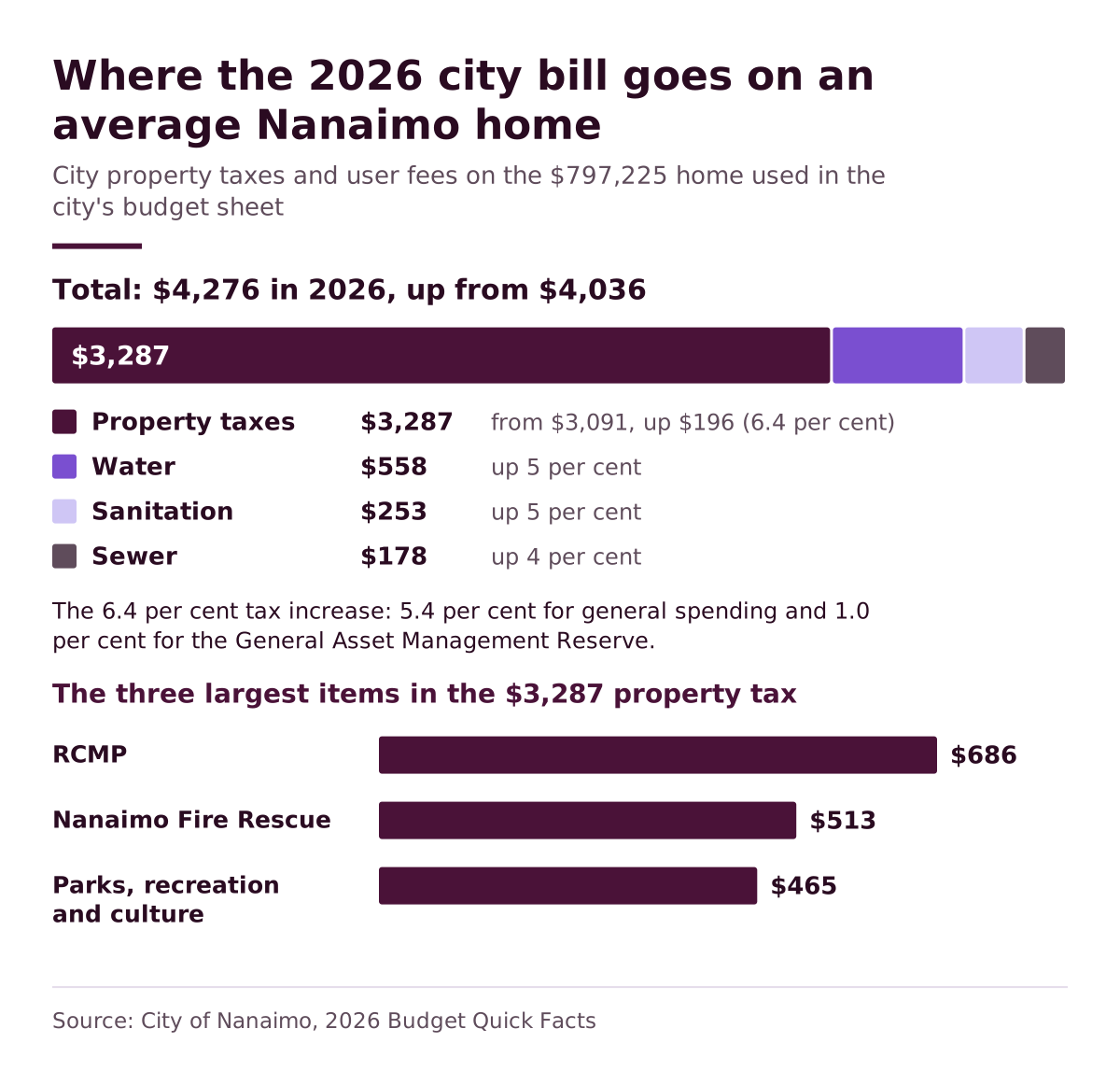
The increase has two parts: 5.4 per cent for general spending and 1.0 per cent for the General Asset Management Reserve. On the $797,225 home, municipal property taxes went from $3,091 to $3,287, a rise of $196. Water fees rose five per cent to $558, sewer fees four per cent to $178 and sanitation five per cent to $253. Altogether the city's taxes and user fees for that home rose from $4,036 to $4,276.
The provisional plan passed in December 2025 had shown 6.3 per cent on an average home of $787,743. Councillors gave the tax bylaws their first three readings on May 4, 2026, ahead of the province's May 15 deadline for five-year financial plans.
The city's own breakdown of the $3,287 puts the RCMP first, at $686, followed by Nanaimo Fire Rescue at $513 and parks, recreation and culture at $465. Projected revenue for 2026 is $295.7 million, 61.0 per cent of it from property taxes and 24.7 per cent from user fees and charges, against a $228.6 million operating budget and $157.9 million in projects. Gaming adds a smaller stream: under the Province's host financial assistance agreements, a municipality that hosts a casino, as Nanaimo does with Casino Nanaimo, typically receives 10 per cent of the facility's net gaming income.
Neighbours made similar choices. Parksville set 5.8 per cent, Qualicum Beach 6.5 per cent and Lantzville five per cent. Most bills were due on July 2.
The regional district's line on the bill
The tax notice carries more than the city's share. The Regional District of Nanaimo approved a 5.7 per cent increase in its property tax requisition for 2026 in late February. Its brochure shows the City of Nanaimo's contribution to regional general services rising from $36,746,420 to $37,594,920, and the estimated bill for the average city home from $725.55 to $741.42, parcel tax included. Transit takes 43 per cent of that money and wastewater services 39 per cent, with regional parks at 7 per cent, administration and grants at 5 per cent, regional development at 4 per cent and solid waste at 2 per cent.
Rural areas saw different numbers. NanaimoNewsNOW reported increases ranging from about $10 for an average home in Area B, Gabriola Island, to about $110 in Area C, Nanaimo Lakes, Extension and Cassidy. The hospital district sets its own increases: on March 24, 2026, the Nanaimo Regional Hospital District adopted a requisition of $49.5 million, 21 per cent more than in 2025, much of it reserves for its share of new projects at Nanaimo Regional General Hospital.
The 2016 core services review and what it cut
The modern argument over Nanaimo's spending starts on May 30, 2016, when council received the final report of its Core Services Review. The consulting firm WMC had produced more than 100 recommendations in 11 areas, from strategic planning and purchasing to grants and performance measures. The report also looked at the city's three external agencies: the Nanaimo Economic Development Corporation, the Downtown Nanaimo Business Improvement Association and the Vancouver Island Conference Centre. It concluded that Nanaimo's services were largely of high quality and that the city compared favourably with similar places on spending and debt.
Some recommendations reached ordinary residents quickly. One proposed closing the Beban Park pool for three months in the summer; at council on August 22, 2016, members of the public spoke on it. Pool closures have been fought over elsewhere in the region too: Qualicum Beach's Ravensong Aquatic Centre closes every August, and a 2025 vote to expand it failed.
The business improvement association felt the review hardest. Late in December 2016, council stopped more than $230,000 a year in grants that had matched, dollar for dollar, what downtown property owners paid through their levy, following the review's finding that city funding for such groups was rare. In March 2017 the association voted to dissolve itself. Eric McLean, who ran a shop on Fitzwilliam Street, counted the vote at 64 to 14. The Times Colonist reported a projected deficit of about $68,000 on revenues of $484,000, and a levy that covered about 700 commercial properties with about 300 owners.
Downtown business groups did not disappear. The Old City Quarter has had its own business improvement area for more than 20 years, now under a 2022 bylaw; its east entrance is marked by the former Willard Service Station at Wallace and Fitzwilliam, built around 1910 and home to New York Style Pizza since 1991. A new Downtown Nanaimo Business Association area was set up in 2026 under a 2025 bylaw. Parking is the other recurring downtown dispute: downtown street parking went free for 17 months before the meters came back on March 2, 2026.
Mega projects: the events centre vote and the borrowing list
The biggest project of the period never got built. In March 2017 the city asked voters to approve borrowing up to $80 million, over no more than 20 years, for an events centre with an ice arena. Chief election officer Sheila Gurrie declared 80.3 per cent of voters against, on a turnout of 35.3 per cent. The money would have gone to a waterfront arena at 1 Port Drive.
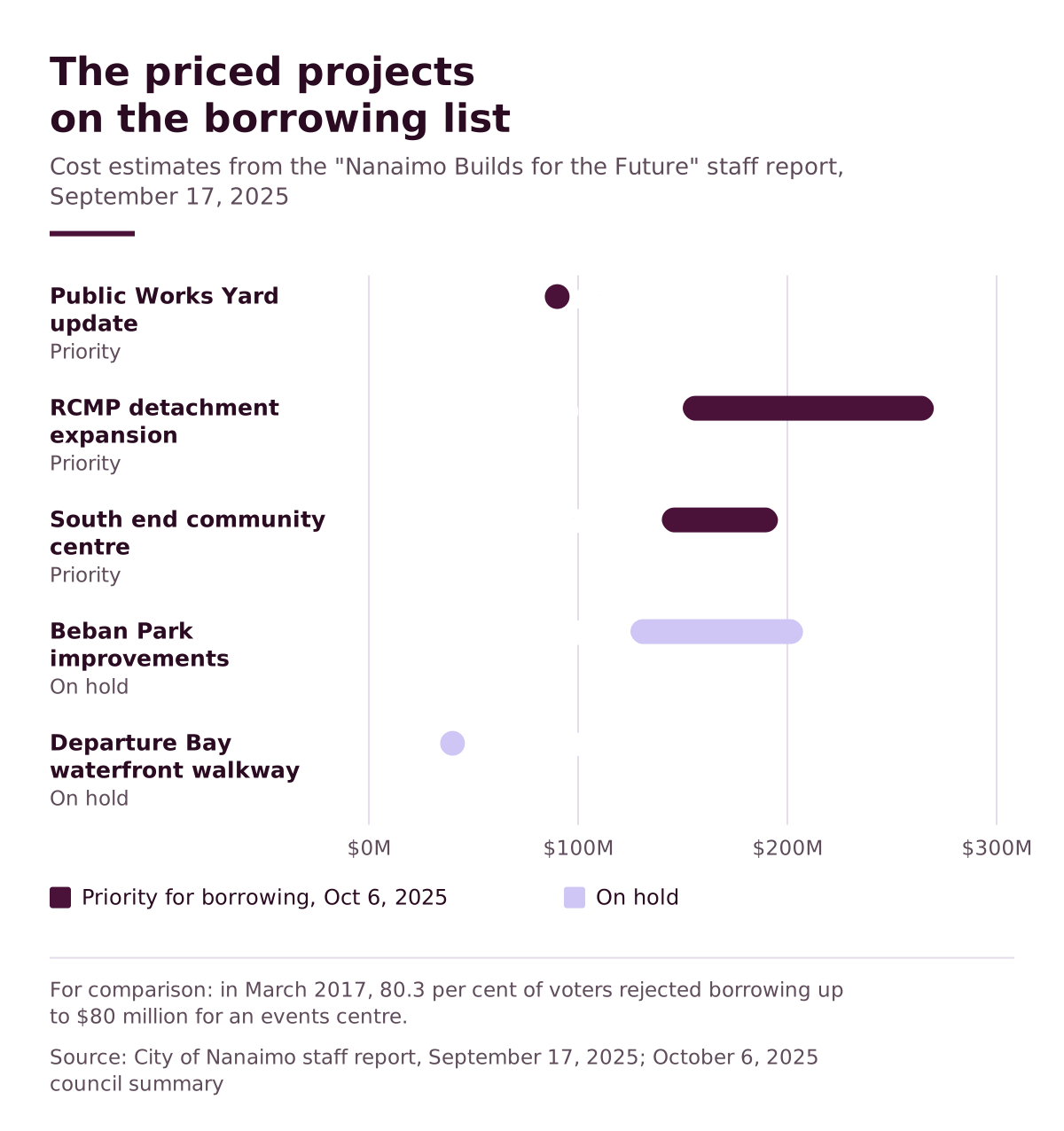
The list that replaced it is longer and costlier. A staff report of September 17, 2025, called "Nanaimo Builds for the Future", priced a Public Works Yard update at $90 million, an RCMP detachment expansion at $150 million to $270 million and a south end community centre at $140 million to $195.5 million. It put the Departure Bay section of the waterfront walkway at about $40 million and Beban Park improvements at $125 million to $207.5 million. On October 6, 2025, council named the first three as the priorities for long-term borrowing and put the walkway and Beban Park on hold until detailed design and costing of the priorities, which staff expected in early 2027.
Council also asked staff to change its debt policy so the city could borrow without a public vote while it stays inside the limit the province allows without elector assent. After 2017, that is not a small change.
Shelter spaces and tree permits
Shelters are largely a provincial responsibility, but council hears the numbers. A BC Housing update to council on March 23, 2026, counted 167 shelter spaces in Nanaimo: 63 permanent and 104 temporary winter spaces, including 60 at St. Peter's that were due to close on March 31. Between April and July 2025, 425 people used a shelter and 43 moved from a shelter into housing. Four HEARTH supportive housing sites held 159 units, of which 139 were occupied; one planned site, the Sparrow on Nelson Street, would not go ahead because of the building's condition. The province's longer housing record is in BC subsidized housing in Nanaimo.
Trees get their own bylaw. Under Bylaw 7126 a permit is needed to cut or prune a significant tree, to remove more than four other trees of 6 cm or more in diameter on one parcel, or to clear land for development. City guidance names three kinds of significant tree, heritage, wildlife and landmark, and sets landmark thresholds by species: 10 cm for a Garry oak or western dogwood, 80 cm for a Douglas fir or western red cedar. The 2026 application form charges $50 to apply, $10 a tree and $100 for each significant tree, to a maximum of $2,500. Breaking the bylaw can bring a fine of up to $50,000. If you are thinking about the big fir by the driveway, measure it at 1.4 metres above the ground before calling anyone.
What council and ferry executives are paid
Council pay is public record. The city's 2024 statement of financial information lists Mayor Leonard Krog at $131,790.28 and each of the eight councillors at $52,014.10, with expenses reported separately.
Halifax, a much larger municipality, sets council pay by formula: it ties council pay to Statistics Canada's average weekly earnings. A December 2023 staff report there noted that the formula had produced an 8.4 per cent raise that November and set out a proposal to cap future raises at 4 per cent for councillors and 2 per cent for the mayor; the order it reproduced named $82,652.64 for councillors and $176,033.75 for the mayor.
BC Ferries, another public body Nanaimo residents pay into through fares, disclosed its executive pay in September 2026. For the fiscal year to March 31, 2026, president and CEO Nicolas Jimenez had a salary of $468,951, up from $459,756, and total compensation of $545,862 under a BC Ferry Authority limit of $571,044. The Departure Bay crossing costs riders time as well, and on summer Sundays and holiday Mondays the longest ferry lineups have historically formed on the Nanaimo side.
The borrowing list returns to council in early 2027 with real designs and prices attached. Whether the waterfront walkway rides along with the police station and the works yard, or waits for another decade, will be decided then.
Questions
What was the typical Nanaimo property assessment for 2026?
BC Assessment put the typical single-family home in the City of Nanaimo at $769,000, up one per cent from $760,000. The typical strata home rose two per cent to $451,000. Both figures reflect market value on July 1, 2025.
How do you appeal a property assessment in Nanaimo?
Contact BC Assessment first, using the details on the notice. If that does not settle it, a formal appeal goes to the Property Assessment Review Panel; for the 2026 roll the deadline was February 2.
How much did Nanaimo property taxes go up in 2026?
Council set a 6.4 per cent increase in municipal property taxes for the average home, made up of 5.4 per cent for general spending and 1.0 per cent for the asset management reserve. On a home assessed at $797,225 that meant $3,287 instead of $3,091.
Does a higher assessment mean a higher tax bill?
Not by itself. Council first decides how much money it needs, then sets rates across the whole roll, so what matters is how your assessment moved compared with the average. A home that rose less than the average can see a smaller increase than the headline figure.
Why are there different 'average home' values for Nanaimo?
They measure different things. BC Assessment publishes a typical single-family value, the City uses an average home of $797,225 to show the effect of its budget, and the Regional District of Nanaimo used an average residential value of $777,123 in its 2026 tax brochure.
What does the Regional District of Nanaimo portion of the tax bill pay for?
For City of Nanaimo properties, the regional district's own brochure shows most of it going to transit and wastewater treatment, with smaller shares for regional parks, administration, regional development and solid waste. The average city home paid an estimated $741.42 for those general services in 2026.
What happened to the Nanaimo events centre?
Voters rejected it. In a March 2017 referendum, 80.3 per cent voted against letting council borrow up to $80 million over 20 years for an events centre with an ice arena, and the project did not go ahead.
Do you need a permit to cut down a tree in Nanaimo?
Often, yes. Under the city's tree bylaw a permit is needed to cut or prune a significant tree, or to remove more than four other trees of 6 cm or more in diameter on one parcel, among other cases. A Garry oak counts as significant from 10 cm across.
How many homeless shelter spaces does Nanaimo have?
A BC Housing update to council in March 2026 counted 167 shelter spaces, of which 63 were permanent and 104 temporary winter spaces due to close by the end of April. It also listed 159 units in four HEARTH supportive housing sites, 139 of them occupied.
How much are Nanaimo city councillors paid?
The city's 2024 statement of financial information lists each councillor at $52,014.10 in remuneration and Mayor Leonard Krog at $131,790.28. Expenses appear in a separate column of the same statement.
How much does the BC Ferries CEO earn?
BC Ferries reported a salary of $468,951 for president and CEO Nicolas Jimenez in the fiscal year to March 31, 2026, up from $459,756. His total compensation was $545,862 against a ceiling of $571,044 set by the BC Ferry Authority's executive pay plan.
Sources
- Vancouver Island 2026 Property Assessments Announced, BC Assessment, 2026-01
- Nominal change in 2026 property assessments for Nanaimo & Oceanside properties, NanaimoNewsNOW, 2026-01-03
- 2026 Budget Quick Facts, City of Nanaimo, 2026
- Provisional budget passes three readings, 2026 user rates set, City of Nanaimo, 2025-12-19
- Property tax rates being locked in across mid-Island communities, NanaimoNewsNOW, 2026-05-11
- Nanaimo 2026 RDN Property Tax Brochure and Supplemental Information, Regional District of Nanaimo, 2026
- Council receives Core Services Review Final Report, City of Nanaimo, 2016-05-31
- August 22, 2016 Regular Council Summary, City of Nanaimo, 2016-08-22
- Downtown improvement group out of business in Nanaimo, Times Colonist, 2017-03-25
- Business Improvement Areas, City of Nanaimo, 2026-01-26
- Re-Focus on Nanaimo's Heritage: From Service Station to Pizza Joint, City of Nanaimo, 2016-01-25
- City completes declaration of referendum results, City of Nanaimo, 2017-03-15
- Nanaimo Builds for the Future Plan Update (staff report), City of Nanaimo, 2025-09-17
- October 6, 2025 Regular Council Summary, City of Nanaimo, 2025-10-06
- HEART and HEARTH Update, BC Housing (presentation to Nanaimo City Council), 2026-03-23
- Management and Protection of Trees Bylaw 2013 No. 7126 (consolidated), City of Nanaimo, 2022-11-21
- Tree Removal/Maintenance Permit Information, City of Nanaimo, 2014-01-07
- Application for Tree Removal Permit, City of Nanaimo, 2026-08-24
- 2024 Statement of Financial Information, City of Nanaimo, 2025-06-16
- Proposed Amendments to Administrative Order 17, Respecting Remuneration for Members of Council, Halifax Regional Municipality, 2023-12-21
- Executive Compensation Disclosure (Coastal Ferry Act), fiscal 2026, British Columbia Ferry Services Inc., 2026-09-25
- Statement of Executive Compensation, fiscal 2026, British Columbia Ferry Services Inc., 2026-09-25


