
Every day the tide runs through a set of concrete step pools on the Nanaimo waterfront and flushes Swy-a-Lana Lagoon, with a weir holding the water level. The saltwater basin was built by the Nanaimo Port Authority in the early 1980s, handed to the city, and described in the city's own planning as the first of its kind in Canada. It sits at the centre of Maffeo Sutton Park, which the City of Nanaimo now calls its busiest park, and which has spent the better part of two decades waiting for a plan to be finished.
From foundry ground to a waterfront park
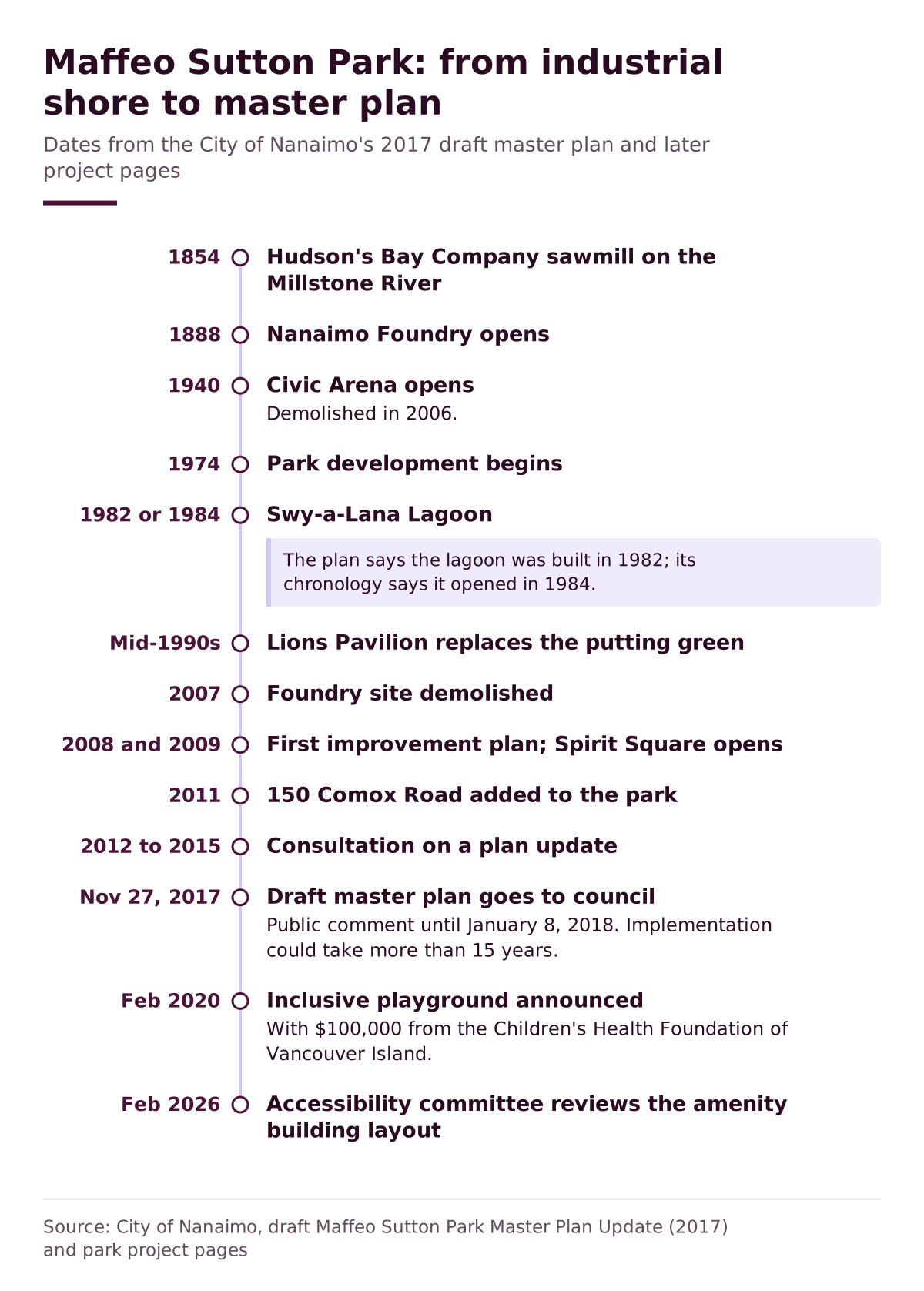
The ground under the park was not always public. The city's 2017 draft master plan lists what stood there before: a foundry, a tannery, a sawmill, a gas station and a shipbuilding company. Its chronology starts with the Hudson's Bay Company running a sawmill on the Millstone River in 1854 and the Nanaimo Foundry opening in 1888. The Civic Arena occupied part of the site from its grand opening in 1940 until it was demolished in 2006.
The same plan opens with an older history. Maffeo Sutton Park lies in the core traditional territory of the Snuneymuxw First Nation, and maps drawn for the coal operations between 1854 and 1862 mark a village or houses on the banks of the Millstone River. Interviews published in a 1992 study, including knowledge passed on from Snuneymuxw elder Albert Wesley, describe a small village with a single longhouse on the south side of the river mouth, and the river as a good place for coho. Two known archaeological sites lie along the river, one inside the park.
Development as a park began in 1974, according to the chronology. Much of the shoreline was filled to make room for a putting green, the lagoon followed (the plan says it was built in 1982, while its chronology says it opened in 1984), and the Harbourfront Walkway came soon after. In the mid-1990s the putting green gave way to the Lions Pavilion and more open grass.
The name honours two men. The draft plan says Pete Maffeo was mayor from 1956 to 1967 and a keen sportsman, and Joseph Sutton a long-time city employee. The city's park listing describes Maffeo as a popular mayor and ice cream shop owner, and Sutton as the long-time caretaker of Deverill Square Park.
The 2008 plan, Spirit Square and the lost development site
The modern planning started with a vote about something else. The 2004 referendum on the Nanaimo conference centre, a new ice centre and the removal of the Civic Arena opened space on the waterfront, and the arena came down two years later. The neighbouring foundry site was demolished in 2007. The conference centre that came out of the same referendum is a 38,000-square-foot building that CHEK News reported cost $74 million.
Under an agreement with the city, Millennium Development Corporation, formerly Triarc International, agreed to buy the foundry site and an adjacent 2.3 acres. The draft plan records that it was never developed and stayed city property. That land, 150 Comox Road, was added to the park in 2011.
A first improvement plan was written in 2008 with public input, and Spirit Square opened in 2009 as its first phase, with picnic tables, benches and a basketball court. The goals set during the 2004 referendum still guided the work in 2017: better performance and play spaces, more waterfront access, no loss of parking, room for special events and historical and industrial interpretation.
What the draft Maffeo Sutton Park master plan proposed
Council started an update in 2012. The park had grown, development applications were piling up beside it, and the city wanted the plan to match its strategic plan. Consultation ran from 2012 to 2015 with surveys and open houses. The draft that resulted put the scale of use plainly: more than 160 groups book the park each year for large special events, and thousands of people use it every day.
The draft Maffeo Sutton Park master plan went to council on November 27, 2017. Council referred it to two committees and asked for it to be posted, and the public had until January 8, 2018, to comment. It called itself a vision needing "substantial funding and partnerships" and said implementation could take more than 15 years.
Its early-action list was modest. It proposed a renewed playground and picnic area, softer edges and a better beach at Swy-a-Lana, entrance signs, a wayfinding kiosk in the parking lot, and interpretive stories and traditional place names. Longer-term ideas included a better connection up the Millstone to Bowen Park, a purpose-built performance space and a new amenity building. The plan also noted that two properties at 50 Comox Road and 100 Cliff Street, part of the old foundry site and known to be archaeologically significant, were to be transferred to the Snuneymuxw First Nation.
There were technical findings too. The draft noted that after more than 35 years of use the lagoon was starting to show wear, and a 2014 condition assessment by Herold Engineering looked at its structure and at problems with the water wall machinery. The neighbouring Georgia Park, which the city acquired in 1944 and 1948, was later wanted in part for a 32-storey Hilton hotel on Front Street, a project that was approved and then shelved.
Where Maffeo Sutton Park stands in 2026
The playground came first. In February 2020 the city announced an inclusive play space built with the Children's Health Foundation of Vancouver Island, which gave $100,000, and the Nanaimo Child Development Centre. Pea gravel was replaced with wood fibre and rubber surfacing, and art by local artist Noel Brown tells a story of life along the Millstone River with coho salmon among the characters.
The amenity building is next. The city says a new building has been considered since 2008 and that more washrooms emerged as a priority during the master plan consultation, because the existing ones cannot cope with event crowds. The design calls for universal washrooms with surge capacity, a green room for performers at the Lions Pavilion and a flex room. Its planned site is northeast of the pavilion, between the Waterfront Walkway and Spirit Square, chosen partly to meet flood construction setbacks. It is paid for by the provincial Growing Communities Fund, and the city's accessibility committee reviewed the layout in a workshop in February 2026.
Whether council ever formally adopted the 2017 draft is less clear. The city's project page still describes the draft returning to council "in the new year," and no adoption vote turned up in the sources reviewed for this article.
If you walk out along the lagoon bridge, the ferry to Saysutshun leaves from the park's edge. The crossing takes about ten minutes.
A shipwreck's cargo and the stone across the harbour
That short crossing connects the park to one of the stranger cargoes in local history. Sandstone quarrying on Newcastle Island began after Joseph Emery of the United States Mint went looking for stone for San Francisco's new mint building; Wikipedia dates the first quarry lease to 1869, while the University of Victoria's place-name notes say the quarries ran from 1870 to 1932.
The barque Zephyr, built in Medford, Massachusetts, in 1855, came to Newcastle Island on January 31, 1872, to load two of the eight sandstone columns ordered for the mint, along with a large number of blocks. It left Departure Bay in stormy weather and struck bottom off the northeast shore of Mayne Island. The Canadian Register of Historic Places dates the sinking to February 13, 1872, and records two deaths, Captain Hepson and one crew member; Wikipedia names the second man as the mate, James Stewart.
The wreck lies in 9 to 12 metres of water between David's Cove and Edith Point, spread over an area about 84 metres long. It is a provincial heritage site, and B.C.'s Heritage Conservation Act makes it illegal to remove anything from it without a permit. The column that was raised is now part of an exhibit about the Zephyr on Saysutshun, and a recovered slab sits outside the Mayne Island Museum. The mint was finished with six columns instead of eight.
Caledonia Park and the Rotary Bowl
Two of the city's older sports grounds sit a few minutes inland. Caledonia Park, at 110 Wall Street beside Bowen Park and the Nanaimo Curling Centre, began as a cricket pitch: the city says the railway company gave the land to the Nanaimo Caledonia Society for one in 1891, and the city acquired it from the railway in 1953. The grandstand and buildings date from the 1950s. Field sports use the grass and the cinder track, and the park hosts annual community events.
The Rotary Bowl changed hands more recently. In February 2017 the city offered $4.1 million for a 5.94-hectare parcel at Nanaimo District Secondary School that included the Rotary Bowl and Serauxmen Stadium, subject to public consultation and approval by the school board and the Ministry of Education. The two sides also agreed to split the cost of an artificial turf field, estimated at $2.4 million. By May 2018 the city described both venues as city-owned and dedicated as park land, and the turf field, lit for evening play, as the largest in Nanaimo.
Serauxmen Stadium has its own history. The Times Colonist reports that it opened on July 31, 1976, on an old mine site behind the school, with Mickey Mantle at the ceremony, and later received a $1.1 million LED lighting system. At the Rotary Bowl, work began at the end of June 2026 on a new high jump area, a new pole vault track to replace one damaged by fire, an extension to the oval and new sod and irrigation. CHLY put the budget at about $1.4 million, including $300,000 from the Community Works Fund.
Harewood Centennial Park and Cinnabar Valley
On the south side of the city, Harewood Centennial Park covers 15.7 acres at 740 Howard Avenue next to John Barsby Community School. Council adopted an improvement plan for it in 2010, and public input during that planning asked for children's play areas that worked year-round. The first phase, finished in 2015, brought what the city said would be Nanaimo's largest playground, climbing wall repairs, a beginner mountain bike area and public access to three more acres. The Nanaimo Lions Club gave $15,000.
The second phase was meant to add a covered sport court, a perimeter trail, a youth park and a better lacrosse box and washrooms. The lacrosse box and covered space were built in 2017, replacing a tennis court. The youth skate park opened on July 6, 2020, with public art by Bracken Hanuse Corlett and Joel Good, including salmon flowing through the river beside the park. A rubberized inclusive play area followed in 2022, and on June 30, 2023, a green-level mountain bike skills park opened, built with the Steve Smith Foundation.
Cinnabar Valley Park is far smaller. The city acquired it in 1980 and updated its single play structure in 2001 through the Volunteers in Parks program; it also has a basketball hoop and tennis courts at 2004 Cinnabar Drive. The city lists it as not wheelchair accessible. Route 7 Cinnabar/Downtown is the bus that serves the neighbourhood, running to the South Parkway Plaza exchange and downtown. Dogs can run on the unfenced trails at Colliery Dam, one of the off-leash parks in Nanaimo, in a park that kept its two coal-era dams after a three-year fight.
Back on the waterfront, a 2013 habitat survey of the lagoon by Aquaparian Environmental Consulting recorded species from the surrounding harbour living in it, among them a rare form of oyster, and follow-up tests found that shutting off the cascading water walls would not change the water's oxygen levels.
Questions
Who is Maffeo Sutton Park named after?
It is named after Pete Maffeo and Joe Sutton. The city's draft master plan says Maffeo was mayor from 1956 to 1967 and Sutton was a long-time city employee; the city's park listing adds that Maffeo ran an ice cream shop and that Sutton was the caretaker of Deverill Square Park for many years.
Can you swim at Swy-a-Lana Lagoon?
Yes, there is a swimming beach, but the city notes there are no lifeguards. The draft master plan says swimming was not encouraged when the lagoon first opened, and the beach became popular later.
Was the Maffeo Sutton Park master plan adopted?
The city presented a draft to council on November 27, 2017, and took public comments until January 8, 2018. The city's project page still describes that draft stage, and no adoption vote was found in the sources reviewed.
What is being built at Maffeo Sutton Park?
A permanent amenity building with universal public washrooms, a green room for events and a flex room. It is planned northeast of the Lions Pavilion, between the Waterfront Walkway and Spirit Square, and is funded through the B.C. Growing Communities Fund.
How do you get to Saysutshun (Newcastle Island) from Maffeo Sutton Park?
A foot-passenger ferry leaves from the park and crosses to the southern end of the island in about ten minutes. The island is otherwise reached only by private boat or kayak.
Where can you see stone from the Zephyr shipwreck?
One of the sandstone columns raised from the wreck is part of an exhibit about the ship on Saysutshun (Newcastle Island). A recovered slab also sits outside the Mayne Island Museum, and the wreck itself is a protected provincial heritage site.
Is Caledonia Park for sale?
Nothing in the city's current listing suggests it. Caledonia Park has been city land since 1953, when it was acquired from the railway company. The nearby Rotary Bowl went the other way: the city bought it from the school district and dedicated it as park land.
Who uses the Rotary Bowl track?
The city says School District 68, Vancouver Island University, the Nanaimo Track and Field Club, recreational runners, walkers and seniors all use it. A roughly $1.4 million upgrade began at the end of June 2026 and was expected to run to October.
What is at Harewood Centennial Park?
An inclusive playground, covered and open hard courts, a lacrosse box, a youth skate park, a water park, a beginner mountain bike skills park and the Sherry Sports Fields. The park is at 740 Howard Avenue next to John Barsby Community School.
Is Cinnabar Valley Park wheelchair accessible?
The city's park listing says it is not. The park has a single play structure updated in 2001, a basketball hoop and tennis courts.
Sources
- Draft Maffeo-Sutton Park Master Plan Update, City of Nanaimo Parks and Recreation, 2017
- Maffeo Sutton Park Master Plan Update, City of Nanaimo
- Maffeo Sutton Park Improvement Plan and Update (timeline), City of Nanaimo, 2017-02-20
- Maffeo Sutton Park, City of Nanaimo Parks Search
- Maffeo Sutton Playground Getting Upgrades, City of Nanaimo, 2020-02-05
- Maffeo Sutton Park Amenity Building, City of Nanaimo
- Zephyr Shipwreck, Canadian Register of Historic Places, 2013-01-11
- Saysutshun (Newcastle Island Marine) Park, Wikipedia
- Newcastle Island, The Colonial Despatches of Vancouver Island and British Columbia (University of Victoria)
- Edith Point, MayneIsland.com
- Caledonia Park, City of Nanaimo Parks Search
- City, School District work together on recreation amenities, City of Nanaimo, 2017-02-09
- Let there be Turf! Community Partnership goes Green, City of Nanaimo and Nanaimo Ladysmith Public Schools, 2018-05-11
- Construction and improvements underway at Nanaimo's Rotary Bowl, CHLY 101.7FM, 2026-07-10
- New lights for Nanaimo stadium, and a plan to reopen ice rinks, Times Colonist
- Harewood Centennial Park Improvements, City of Nanaimo
- Harewood Centennial Park to Get New (and Improved) Playground, City of Nanaimo, 2015-02-19
- Harewood Centennial Park playground officially reopens, City of Nanaimo, 2015-07-10
- Harewood Centennial Park, City of Nanaimo Parks Search
- New mountain bike skills park opens in Harewood Centennial Park, City of Nanaimo, 2023-06-30
- Cinnabar Valley Park (Stacey), City of Nanaimo Parks Search
- Nanaimo Regional Transit System Rider's Guide, effective September 6, 2026, BC Transit and Regional District of Nanaimo, 2026-09-06


