
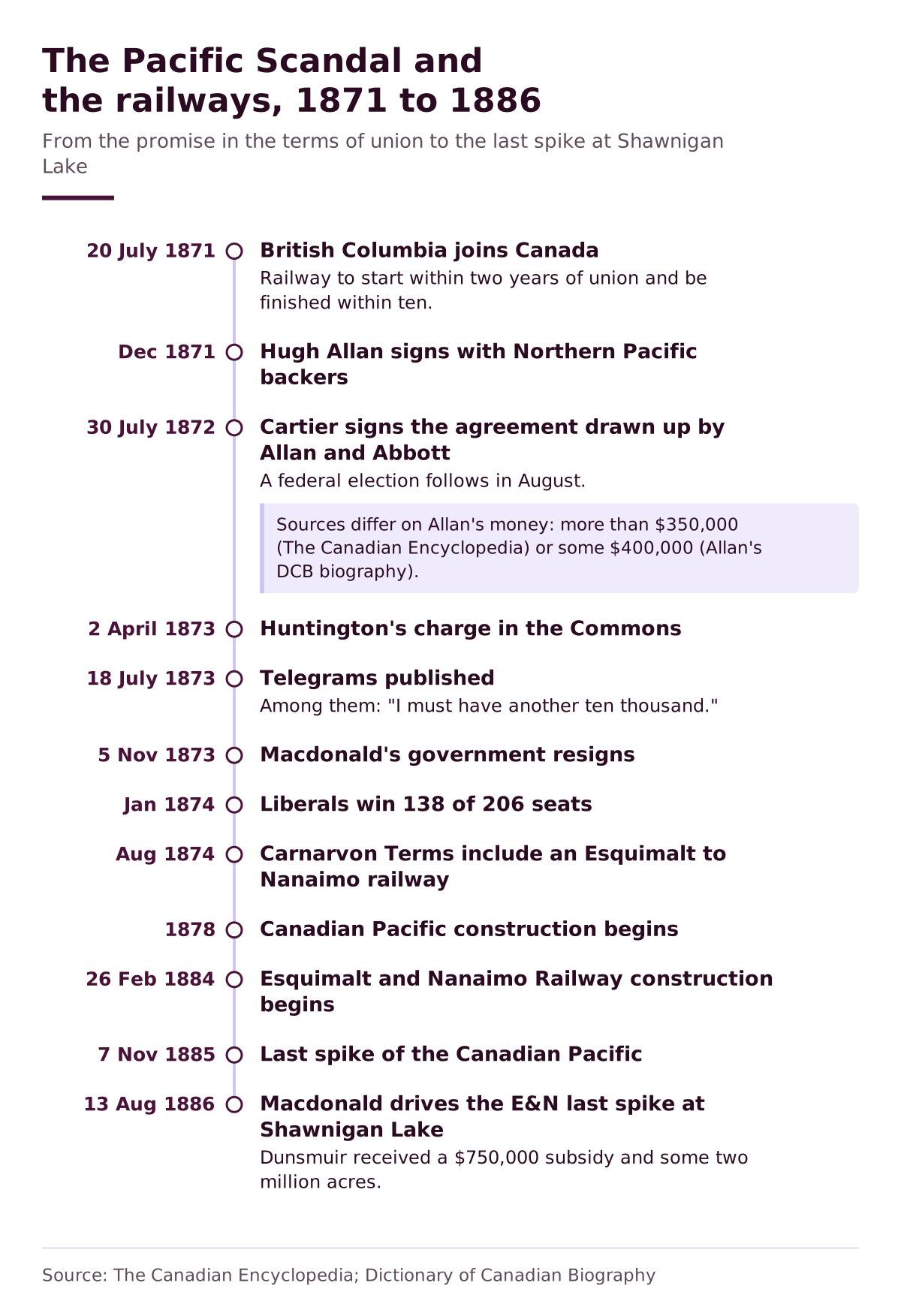
On 2 April 1873 Lucius Seth Huntington, a Liberal member, rose in the House of Commons and made a charge that would bring down Canada's first government. Sir Hugh Allan, he said, had bought control of the railway to the Pacific with money from American backers, and had handed large sums to senior ministers during the election of the previous summer. Prime Minister John A. Macdonald's party voted down his motion for an inquiry. Seven months later the government was gone.
The Pacific Scandal is usually told as an Ottawa story, a tale of telegrams, prorogation and a prime minister drinking through the worst weeks of his career. It began, though, with a promise made to British Columbia, and it ended, more than a decade later, with a railway between Esquimalt and Nanaimo and a land grant of some two million acres.
A railway written into the terms of union, 1871
British Columbia joined Canada on 20 July 1871 as its sixth province. The terms negotiated in Ottawa the year before, and passed by both the colonial assembly and Parliament in 1871, contained the clause that made the deal. The federal government undertook to start building a railway "from the Pacific towards the Rocky Mountains" and from a point east of the mountains towards the Pacific, both within two years of union, and "to secure the completion of such railway within ten years from the date of the Union."
British Columbia's side of the bargain was land. The province agreed to convey to Ottawa, in trust for the railway, a belt of public land along the line, not more than 20 miles on each side, and to stop selling public land in that belt except to settlers who lived on it until construction began. In return the Dominion would pay the province $100,000 a year. If you read the terms in the federal Justice department's consolidation, the railway sits a few lines below a promise that Ottawa would use its influence to keep the naval station at Esquimalt.
Jon Tattrie's history of BC and Confederation for The Canadian Encyclopedia names the railway, along with fear of American annexation after the Alaska purchase of 1867, as a decisive factor in the colony's decision. It was also an enormous commitment. The encyclopedia's entry on the scandal notes that the proposed line was 1,600 km longer than the first American transcontinental, to be paid for by a country of about three and a half million people. Macdonald himself warned Governor Anthony Musgrave in September 1870, according to his biography in the Dictionary of Canadian Biography, that the terms would meet "considerable opposition" in Parliament as too burdensome to Canada and too liberal to British Columbia.
Hugh Allan's syndicate and the money of 1872
Who would build it was the next question. By 1872 at least three, possibly four, Canadian groups wanted the contract, and the two that mattered were Allan's in Montreal and David Lewis Macpherson's in Toronto. Allan was a shipping magnate who had moved into railways, banking and finance, and his biographers in the Dictionary of Canadian Biography call him probably the country's most important capitalist of the 1870s.
He also had American partners. In August 1871 the finance minister, Francis Hincks, told Allan that Northern Pacific Railroad backers led by George William McMullen and Charles Mather Smith were interested in the Pacific contract, and in December Allan signed an agreement with them. Macpherson, hostile to American involvement, formed a rival syndicate. In June 1872 the two were incorporated as competing companies, Macpherson's as the Inter-oceanic Railway Company of Canada and Allan's as the Canada Pacific Railway Company.
A federal election was called for August 1872, and the Conservatives needed money in Ontario and Quebec. Macdonald left Montreal to George-Étienne Cartier and Hincks. On 30 July, Allan's biography records, Cartier signed an agreement drawn up by Allan and his lawyer, John Abbott, that gave Allan what he wanted on the railway. Macdonald's own biography says he knew nothing yet of that commitment, under which Allan's group was guaranteed the charter and a majority of the stock in return for more election money.
The amount is where the sources part company. The Canadian Encyclopedia says Allan donated more than $350,000 to the Conservative campaign. Macdonald's biography describes Cartier's commitments as totalling more than $350,000, and says that when Allan finally told Macdonald the figure, it seemed so fantastic that Macdonald did not believe him. Allan's biography puts his contribution at some $400,000, and adds that his lawyer thought Conservative policy so useful to Allan that three times as much would have been justified. Macdonald's personal share is clearer: some $35,000 for Ontario, plus an emergency draft of $10,000 on 26 August.
The money did not buy much. Cartier lost his own seat in Montreal East despite what Allan's biographers call massive last-minute contributions, and Macdonald won 42 of Ontario's 88 seats, if that. Late in 1872 Allan was given the task of forming a company to build the railway. Macdonald then forced him to break with his American partners, who threatened to reveal their part in the railway and in the campaign.
Stolen letters and a charge in the Commons
Allan sailed for England late in February 1873 to raise capital, without success. Back in Ottawa, the rumours that had filled Montreal for months were about to become documents.
The way they surfaced is a story in itself. The Canadian Encyclopedia relates that Allan was a prolific letter-writer who kept records of his correspondence with Macdonald and Cartier. While Allan and Abbott were in England, Abbott's private secretary, George Norris, and an accomplice stole incriminating letters and sold them to Liberal members for $5,000. The Liberals, under their new leader Alexander Mackenzie, now had paper.
Huntington's charge of 2 April was the result. Macdonald answered that his "hands were clean" because he had not profited personally. The Canadian Encyclopedia adds an uncomfortable detail: by his own admission Macdonald could not remember periods of the 1872 campaign and of his dealings with Allan. His DCB biography says perhaps his worst period of drinking came in 1872 and 1873, during the election and the scandal. Cartier, the man who had signed the agreement, was dying of Bright's disease in London and did not live to answer. He died on 20 May 1873.
The telegrams, the prorogation and 5 November
On 18 July Liberal newspapers published telegrams that Macdonald's biographers call damning, showing that he, and especially Cartier and Hector-Louis Langevin, had accepted large sums from a financier with whom the government was negotiating a railway contract. The most quoted was Macdonald's telegram to Abbott: "I must have another ten thousand; will be the last time of calling; do not fail me; answer today."
With the parliamentary committee's report likely to implicate him, Macdonald asked the governor general, Lord Dufferin, to prorogue Parliament. Dufferin granted ten weeks, and warned him that "your personal connection with what has passed cannot but fatally affect your position as minister." Macdonald appointed a royal commission to sit in the meantime, and Allan came home to testify before it.
When the Commons met again in late October, the defections began, Donald Smith among them. Macdonald made a great rallying speech on the night of 3 November, but by then he had lost. His government resigned 36 hours later, on 5 November 1873. The Canadian Encyclopedia's account words the end slightly differently, saying Macdonald asked Dufferin to dissolve Parliament that day; the DCB biographies of Macdonald, Allan and Mackenzie all describe it as the government's resignation or collapse. Mackenzie became prime minister, called an election, and in January 1874 the Liberals won 138 of 206 seats.
Mackenzie, Carnarvon and the island line that stalled
The scandal did not cancel the promise to British Columbia, but it changed who had to keep it. Allan's company never started work. Mackenzie's Liberals had recoiled from the deal since 1871; his DCB biographer writes that Mackenzie would describe building, at enormous cost within ten years, a railway to serve a tiny population as an act bordering on fiscal insanity. The Conservatives had not begun construction, and Victoria was already complaining.
Mackenzie asked the province to accept a new timetable. In February 1874 he sent J. D. Edgar west as his envoy, but Premier George Anthony Walkem rejected Edgar in May and protested to London. The colonial secretary, Lord Carnarvon, offered to arbitrate and in August delivered what became known as the Carnarvon Terms, less than British Columbia wanted but more than Mackenzie was prepared to spend. One key element was a railway on Vancouver Island between Esquimalt and Nanaimo. The Senate, dominated by Conservatives, refused to pass the Commons bill to finance it. Only in 1876 was a compromise reached under which Mackenzie agreed to start construction in British Columbia two years later.
The mainland railway did eventually come. Macdonald returned to power in the 1878 election, and construction of the Canadian Pacific began that year after many delays, according to The Canadian Encyclopedia. A new contract waited until 1880. The line was finished in 1885, and on 7 November Donald Smith, one of the men who had deserted Macdonald in 1873, drove the last spike. Macdonald's biography records another cost of the line: an estimated 15,000 to 17,000 Chinese workers passed through British Columbia by the time it was completed, most of them to build it, and anger over that labour shaped provincial politics for years, a history that runs straight into Nanaimo's Chinatown.
Dunsmuir's railway and the two-million-acre grant
The island line had its own long road. A railway between Nanaimo and Victoria had been planned as early as 1873, according to the DCB biography of Robert Dunsmuir, but nothing serious happened until December 1883, when the province transferred enough Crown land to Ottawa for the project. Many businessmen and politicians wanted Dunsmuir, the Nanaimo coal owner whose Wellington mines had made him rich, to build it. Their concern, his biographer writes, was to keep the Northern Pacific Railroad from winning the contract, the same American railroad whose backers had stood behind Allan a decade earlier.
Dunsmuir drove a hard bargain. In exchange for building the Esquimalt and Nanaimo Railway he received a subsidy of $750,000 and some two million acres, which his biographer describes as fully one-fifth of Vancouver Island. The grant came with "all coal, coal oil, ores, stones, clay, marble, slates, mines, minerals, and substances whatsoever" in or under the land, the foreshore rights, mining rights under nearby seabeds, and the right to cut whatever timber the line required. Settlers could buy farmland from the grant at one dollar an acre, and squatters of at least a year could buy up to 160 acres. Daniel Gallacher, the DCB author, calls it "a major give-away of British Columbia's natural resources." The coal that made the grant so valuable came from seams like the Wellington, the thickest and most extensive seam yet found in the Nanaimo coal basin when Dunsmuir struck it in 1869, and the province's place-name record for Diver Lake, on the old Wellington ground north of town, ties that lake to a mine collapse.
Dunsmuir, chosen to keep Americans out, hired Americans to help build it. The contract named Charles Crocker, Mark Hopkins, Leland Stanford and Collis Potter Huntington, all officials of the Southern Pacific Railroad, as subcontractors. Construction began at Esquimalt on 26 February 1884. On 13 August 1886 the prime minister drove the last spike at Shawnigan Lake. It was Macdonald, thirteen years after the railway scandal had cost him his government. By September trains were running into Victoria on track laid from Esquimalt across Indigenous lands that, in Gallacher's words, Dunsmuir "had managed to have expropriated for his use."
More of Nanaimo's nineteenth century is gathered in the Nanaimo history section.
Questions
What was the Pacific Scandal in simple terms?
Sir Hugh Allan, a Montreal shipping magnate, poured money into the Conservative campaign of 1872 while his syndicate was seeking the charter for the railway to the Pacific. When letters and telegrams proving the link were made public in 1873, John A. Macdonald's government lost the confidence of its own members and resigned.
How much money did Hugh Allan give the Conservatives?
The sources do not agree on a single figure. The Canadian Encyclopedia says more than $350,000, Macdonald's biography in the Dictionary of Canadian Biography describes commitments totalling more than $350,000, and Allan's own biography in the same dictionary puts it at some $400,000.
Did John A. Macdonald take money personally?
His Dictionary of Canadian Biography entry says he received some $35,000 from Allan for the Ontario campaign, plus an emergency draft of $10,000 on 26 August 1872. Macdonald insisted his hands were clean because he had not profited personally, and the same biography says the money he raised never stuck in his pockets.
When did Macdonald resign over the Pacific Scandal?
His government resigned on 5 November 1873, about 36 hours after a long rallying speech in the Commons on the night of 3 November. Alexander Mackenzie's Liberals took office and won 138 of 206 seats in the election of January 1874.
Who exposed the Pacific Scandal?
Liberal MP Lucius Seth Huntington raised the charges in the House of Commons on 2 April 1873. According to The Canadian Encyclopedia, the documents behind them had been stolen by George Norris, private secretary to Allan's lawyer John Abbott, and an accomplice, and sold to Liberal members for $5,000.
What did British Columbia's terms of union promise about the railway?
Ottawa undertook to start building a railway from the Pacific towards the Rocky Mountains, and from the east towards the Pacific, within two years of union, and to finish it within ten years. British Columbia in turn agreed to hand over a belt of public land along the line, up to 20 miles on each side, for an annual payment of $100,000.
What were the Carnarvon Terms?
They were a compromise proposed in 1874 by the British colonial secretary, Lord Carnarvon, after British Columbia protested to London about the delayed railway. Mackenzie's government accepted them grudgingly, but the Conservative-dominated Senate refused to finance one key element, a railway between Esquimalt and Nanaimo.
How is the Pacific Scandal connected to the Esquimalt and Nanaimo Railway?
The island line was part of the bargaining over the delayed transcontinental railway that followed the scandal. It was finally built by Nanaimo coal owner Robert Dunsmuir between 1884 and 1886, in return for $750,000 in cash and roughly two million acres of land.
How big was the Dunsmuir land grant?
The Dictionary of Canadian Biography describes it as some two million acres, fully one-fifth of Vancouver Island. The grant included coal and other minerals, foreshore rights and timber for building the line, with provisions for settlers to buy farmland at one dollar an acre.
Did the Pacific Scandal end Macdonald's career?
No. Caucus refused his offer to step down as leader the day after the resignation, and his Conservatives returned to power in the 1878 election. He remained prime minister until his death in 1891.
When was the Canadian Pacific Railway finally completed?
Construction under the terms of union began in 1878 after long delays, according to The Canadian Encyclopedia, and the line was finished in 1885. Donald Smith, who had deserted Macdonald during the scandal, drove the ceremonial last spike on 7 November 1885.
Sources
- Pacific Scandal, The Canadian Encyclopedia, Historica Canada, 2021-01-14
- British Columbia and Confederation, Jon Tattrie, The Canadian Encyclopedia, Historica Canada, 2020-01-16
- MACDONALD, Sir JOHN ALEXANDER, J. K. Johnson, P. B. Waite, J. R. Miller and Patricia E. Roy, Dictionary of Canadian Biography, vol. 12
- ALLAN, Sir HUGH, Brian J. Young with Gerald J. J. Tulchinsky, Dictionary of Canadian Biography, vol. 11
- MACKENZIE, ALEXANDER, Ben Forster, Dictionary of Canadian Biography, vol. 12
- DUNSMUIR, ROBERT, Daniel T. Gallacher, Dictionary of Canadian Biography, vol. 11
- Order of Her Majesty in Council admitting British Columbia into the Union, dated the 16th day of May, 1871, Department of Justice Canada, A Consolidation of the Constitution Acts, 1871-05-16
- The Province of British Columbia, Enactment No. 4: Schedule (terms of union), Department of Justice Canada, A Consolidation of the Constitution Acts, 1871


