
On March 2, 1923, in Washington, two men put their names to a short fisheries agreement. One was Charles Evans Hughes, the United States secretary of state. The other was Ernest Lapointe, Canada's minister of marine and fisheries. The document, formally the Convention for the Preservation of the Halibut Fishery of the Northern Pacific Ocean, ran to five articles and dealt with one fish. What made it famous in Canada was the signature that was missing: no British diplomat signed it.
The Halibut Treaty of 1923 is remembered for two firsts. The Canadian Encyclopedia calls it the first treaty negotiated and signed independently by the Canadian government, and the first environmental treaty aimed at conserving an ocean fish stock. Both parts of that story run through the waters off British Columbia.
A fishery in trouble, 1888 to 1918
The pressure on Pacific halibut built quickly. Large-scale commercial fishing began in 1888, according to HistoryLink, the online encyclopedia of Washington State history, once the Northern Pacific Railway made it possible to ship fish east. The Atlantic halibut fishery had already been depleted by demand from Europe and the eastern United States.
By 1915 the Pacific fleet numbered 97 vessels and landed about 69 million pounds of halibut, HistoryLink reports. Within a few years the annual take had dropped to about 50 million pounds, and studies showed the stock declining. The grounds were shared, and much of the fishing happened in international waters, so neither country could fix the problem alone.
Negotiations between Canada and the United States began in 1918. A draft convention in 1919 included controversial provisions and was never ratified. The version that reached signature in 1923 was narrower and concentrated on conservation.
People on the halibut grounds before the fleet
Halibut fishing did not begin with the schooners, and a short step aside is worth it here. The International Pacific Halibut Commission notes that Indigenous peoples of the eastern North Pacific fished halibut by hook and line from large canoes that could go as far as 20 miles, about 32 km, from shore. Their carved hooks were selective for large fish suitable for drying and smoking.
The commission quotes the anthropologist Franz Boas on the technique: "Halibut are caught with hooks made of crooked branches of red or yellow cedar, attached to fishing-lines made of red cedar bark sixty fathoms long." HistoryLink adds that as late as the 1880s Indigenous fishers still dominated halibut fishing in Washington. Today, according to the commission, halibut remains an important subsistence and ceremonial food, served at weddings, funerals and naming ceremonies. On the mid-island side, Coast Salish weavers turned mountain-goat wool and woolly-dog hair into blankets that marked status.
What the convention said
The text itself is brief. Article I closed the halibut fishery off the west coasts of the United States and Canada, including the Bering Sea, from November 16 to February 15 each year. Vessels caught fishing for halibut out of season could be seized and handed over to their own country, under Article II. Other fishing could continue during the closed season.
Article III set up the International Fisheries Commission, with four members, two appointed by each country, to "make a thorough investigation into the life history of the Pacific halibut" and recommend regulations. Article V set a minimum term of five years.
The draft had been prepared on the American side. In Hughes's summary of a June 1923 meeting with a Canadian official, the convention had been "drafted in Washington and was an American document with only one or two insignificant and verbal changes offered by the Canadians." Those changes, recorded in diplomatic notes in February 1923, swapped the word "Ministry" for "department" and added the Bering Sea to the commission's remit.
Lapointe's signature and the British objection
The Canadian side of the story is about who signed. Until then, HistoryLink notes, British officials had always signed Canadian treaties alongside Canadians. This time Prime Minister William Lyon Mackenzie King argued, according to the Canadian Encyclopedia, that the agreement concerned only Canada and the United States and touched no British or imperial interest, so Britain should not appear as a signatory.
The British wanted to sign, as they always had, the encyclopedia says. King held his position and threatened to send a separate Canadian representative to Washington, and the British gave way. The precedent was confirmed by the Imperial Conference of 1923.
The formal picture was more mixed than the symbol. The treaty's own preamble names the King "of the United Kingdom of Great Britain and Ireland, and of the British Dominions beyond the Seas" as a party, with Lapointe as his plenipotentiary, and the U.S. Treaty Series lists it as a convention between the United States and Great Britain. A U.S. account of a June 1923 meeting records the Canadian deputy minister of marine saying Lapointe "was duly authorized to do so by the British Government."
Lapointe himself, according to the Dictionary of Canadian Biography, had become minister of marine and fisheries on December 29, 1921, after asking for the justice portfolio. His biographer describes the signing "without a British co-signatory" as a precedent for dominion autonomy.
The Senate reservation of 1923
The treaty nearly died in Washington. On March 4, 1923, two days after signing, the U.S. Senate gave its consent with an added understanding: that "none of the nationals and inhabitants and vessels and boats of any other part of Great Britain" would fish for halibut against the treaty's terms.
The British ambassador asked what "any other part of Great Britain" meant, pointing out that Canada "cannot, of course, properly be described as 'a part of Great Britain.'" Secretary Hughes replied on April 4 that Senator Jones of Washington State, who had introduced the resolution, intended it to cover any part of the British Empire.
For Ottawa that defeated the purpose. At a meeting in New York on June 14, 1923, Alexander Johnston, Canada's deputy minister of marine, told the U.S. under-secretary of state, William Phillips, that the reservation would oblige Canada to go down on "bended knees" to Britain and every self-governing dominion. As it stood, according to Hughes's summary of the meeting, the treaty "must, therefore, be considered as dead." President Warren Harding replied on June 20 that he would resubmit the treaty to the Senate without the reservation.
The delay cost a season. In September 1923, the British chargé in Washington wrote that the closed season could not take effect that winter, since the Senate would not sit again until December.
Ratification and the commission, 1924 onward
The fix came the following year. According to the International Pacific Halibut Commission, the Senate ratified the convention on May 31, 1924, the president on June 4 and Great Britain on July 21. Ratifications were exchanged on October 21, 1924, and the convention came into force that day.
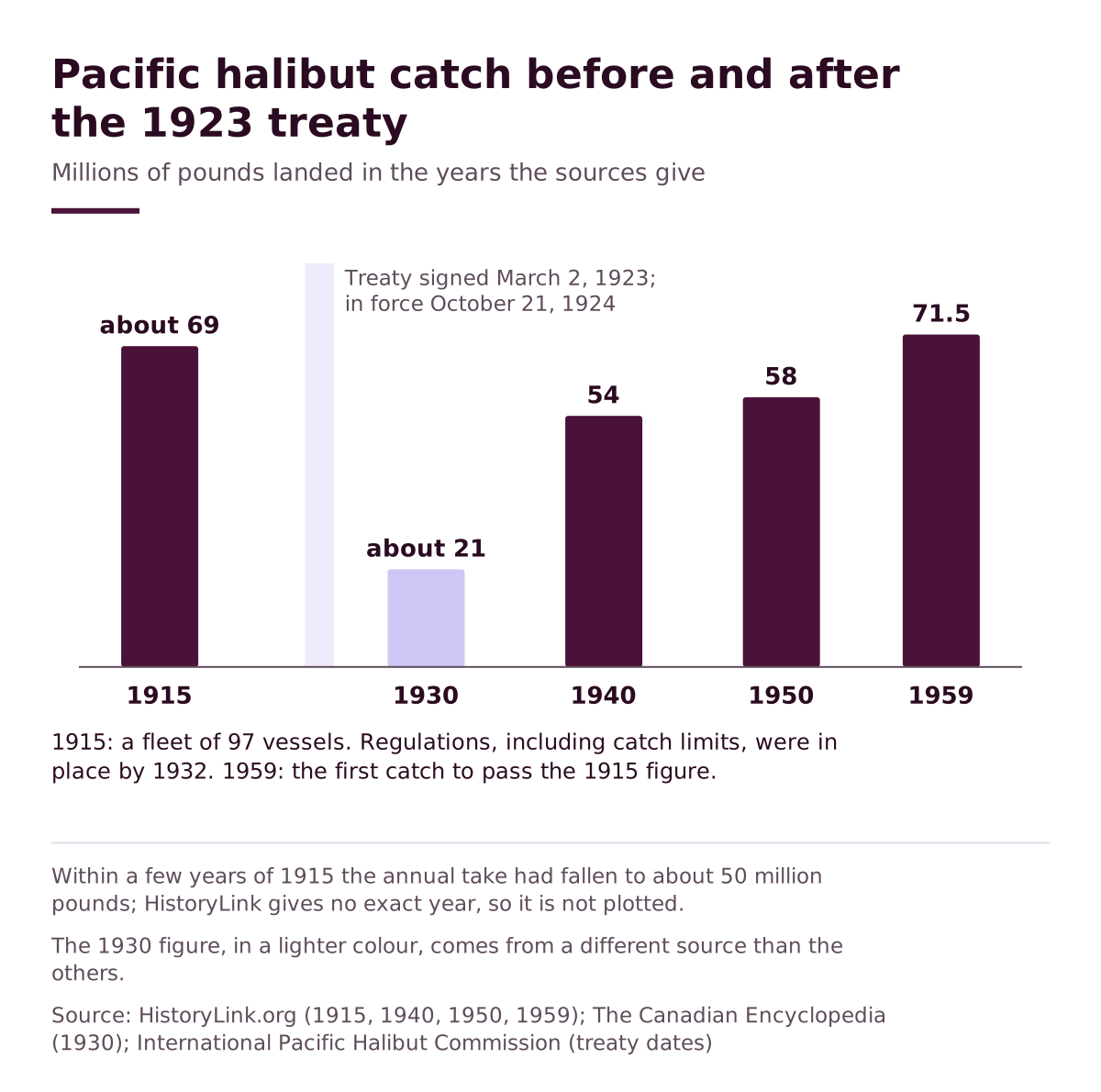
The commission's first years did not stop the decline. Stocks kept falling, to about 21 million pounds by 1930, the Canadian Encyclopedia notes, partly because the 1923 treaty gave the commission no power to put its regulations into effect. A new convention signed on May 9, 1930, replaced the original. Further revisions followed in 1937 and 1953, with a protocol in 1979.
The sources differ on some of these details. A case study by fisheries consultant Christopher Sporer, published by the Food and Agriculture Organization of the United Nations, describes the convention as "signed in 1924" and says the International Fisheries Commission became the International Pacific Halibut Commission in 1953. The commission's own record gives March 2, 1923, as the signing date and 1924 as the year of ratification. The Canadian Encyclopedia mentions the renaming without a year, and HistoryLink says only that it came when other fisheries commissions were set up.
With regulations in place by 1932, including catch limits, gear restrictions and closed nursery areas, the stock began to recover. HistoryLink records catches of 54 million pounds in 1940 and 58 million in 1950, and in 1959 a catch of 71.5 million pounds finally passed the 1915 figure.
From open access to quotas in BC waters
The later history in Canadian waters turned on who could fish where. According to Sporer's FAO case study, the 1979 changes to the convention kept Canadian halibut vessels out of U.S. waters and American vessels out of Canadian waters, and gave each government power to regulate its own fleet. Canada introduced limited entry the same year, and 435 vessels qualified for a halibut licence.
The fleet became much more efficient. In 1980, the same study says, it took 65 days to catch 5.7 million pounds; in 1990 it took six days to catch 8.5 million. The race for fish produced short, unsafe seasons, waste and low prices, and between 1979 and 1990 the fleet exceeded its catch limit in every season except 1980.
In 1989 a small group of licence holders asked Fisheries and Oceans Canada to help design an individual quota system. Individual vessel quotas began in 1991 as a two-year trial and stayed. Sporer reports that the season grew from six days to about nine months, and that the number of people employed in harvesting fell from about 1,600 a year before 1991 to about 950.
The waters off British Columbia now form IPHC Regulatory Area 2B; if you ever read the commission's catch tables, that is the line for the B.C. coast. The commission sets the area's total allowable catch and fishing period, and Fisheries and Oceans Canada divides it among user groups. For 2026, the commission lists the directed commercial fishery in Area 2B as open from March 26 to December 7.
Reading the treaty a century on
The Canadian Encyclopedia places the treaty among several steps toward Canadian autonomy, followed by the Balfour Report of 1926 and the Statute of Westminster of 1931. It also reads the treaty as a sign of Canada's economic turn from Britain toward the United States in the 1920s. Fifty years earlier, Hugh Allan's election money for a railway charter had brought down Macdonald in the Pacific Scandal of 1873. The year of the treaty also brought a very different federal law home to Nanaimo's Chinatown: the Chinese Immigration Act of July 1, 1923, which replaced the head tax with a near-total ban on Chinese immigration.
The commission that began with four members studying one fish is still at work; HistoryLink placed its headquarters at the University of Washington in Seattle when it wrote in 2009. The same account quotes the legal scholar Robert R. Wilson, who wrote that it was with the 1923 signing "that, in the picturesque language of an Irish editor, Canada really began to 'sign her own cheques.'"
Questions
What was the Halibut Treaty of 1923?
It was a convention between Canada and the United States to protect the Pacific halibut fishery, formally the Convention for the Preservation of the Halibut Fishery of the Northern Pacific Ocean. It set a winter closed season and created a joint commission to study the fish.
Who signed the Halibut Treaty?
Ernest Lapointe, Canada's minister of marine and fisheries, signed for Canada, and Charles Evans Hughes, the U.S. secretary of state, signed for the United States. The signing took place in Washington on March 2, 1923.
Why is the Halibut Treaty important in Canadian history?
It is described by the Canadian Encyclopedia as the first treaty negotiated and signed independently by the Canadian government. No British diplomat signed it, which set a precedent for Canada conducting its own foreign relations.
Did Britain have any role in the treaty?
Formally, yes. The treaty text names the King as a party, and U.S. documents of the time call it a convention between the United States and Great Britain; British ratification was recorded on July 21, 1924. What Canada refused was a British co-signature.
Why did the U.S. Senate cause problems?
The Senate approved the treaty on March 4, 1923, with an understanding that it would also bind every other part of the British Empire. Canada's deputy minister of marine said that would force Ottawa to seek the consent of Britain and all the dominions, so Canada would not ratify it in that form.
When did the Halibut Treaty come into force?
It came into force on October 21, 1924, when ratifications were exchanged, according to the International Pacific Halibut Commission. The U.S. Senate had approved it without the earlier reservation on May 31, 1924.
What did the treaty actually require?
It banned halibut fishing off the west coasts of both countries, including the Bering Sea, from November 16 to February 15 each year, with vessels liable to seizure. It also set up a four-member commission, two from each country, to investigate the life history of the halibut.
What is the International Pacific Halibut Commission?
It is the body that grew out of the commission created in 1923, first named the International Fisheries Commission. It still sets the total allowable catch and fishing period for areas such as 2B off British Columbia, and HistoryLink reported its headquarters at the University of Washington in Seattle.
Did the 1923 treaty save the halibut stocks?
Not by itself. Catches kept falling to about 21 million pounds in 1930, and a new convention in 1930 gave the commission powers to impose regulations; the catch recovered to 71.5 million pounds by 1959.
How is halibut fishing managed in BC today?
British Columbia waters form IPHC Regulatory Area 2B. The commission sets the overall limit and season, and Fisheries and Oceans Canada divides the catch, with each licensed vessel holding a percentage under an individual vessel quota system introduced in 1991.
Who was Ernest Lapointe?
Lapointe was a Quebec lawyer and Liberal MP, born in 1876, who became minister of marine and fisheries in December 1921. He later served as minister of justice and was Prime Minister Mackenzie King's Quebec lieutenant until his death in 1941.
Sources
- Halibut Treaty, The Canadian Encyclopedia
- Treaty Series No. 701: Convention between the United States of America and Great Britain, signed at Washington, March 2, 1923, Office of the Historian, U.S. Department of State (Foreign Relations of the United States, 1923, Vol. I)
- The Secretary of State to the British Ambassador (Geddes), March 5, 1923, Office of the Historian, U.S. Department of State
- The Secretary of State to the British Ambassador (Geddes), April 4, 1923, Office of the Historian, U.S. Department of State
- The Secretary of State to President Harding, June 16, 1923, Office of the Historian, U.S. Department of State
- President Harding to the Secretary of State, June 20, 1923, Office of the Historian, U.S. Department of State
- The British Chargé (Chilton) to the Secretary of State, September 6, 1923, Office of the Historian, U.S. Department of State
- Background: Basic Texts, International Pacific Halibut Commission
- Commercial Fisheries, International Pacific Halibut Commission
- Subsistence Fisheries, International Pacific Halibut Commission
- Canada and the United States sign the Pacific Halibut Convention on March 2, 1923, Kit Oldham, HistoryLink.org Essay 9152, 2009-09-10
- Initial allocation of transferable fishing quotas in Canada's Pacific marine fisheries, C. Sporer, in Case studies on the allocation of transferable quota rights in fisheries (FAO)
- LAPOINTE, ERNEST, John MacFarlane, Dictionary of Canadian Biography, vol. 17


